
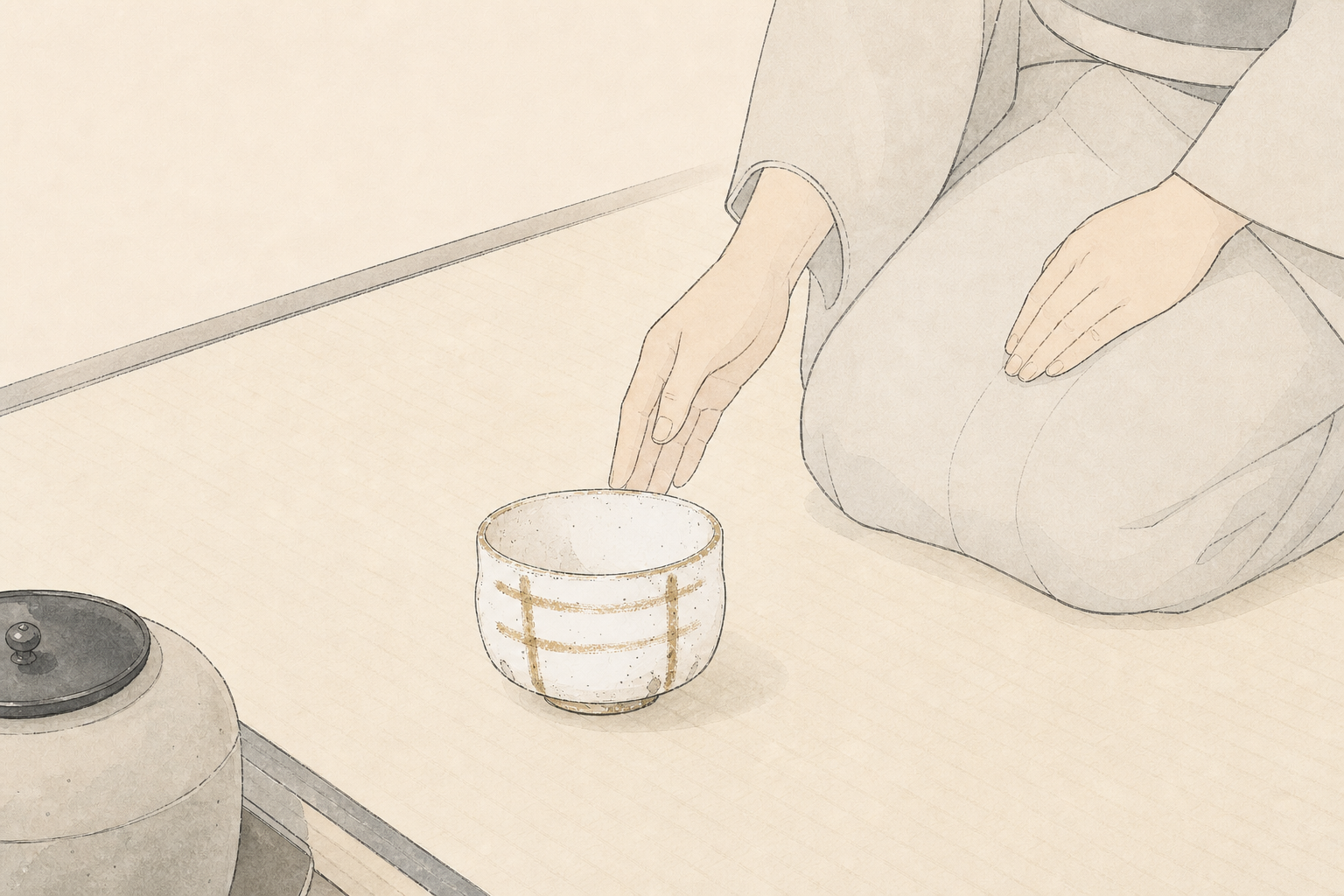
Temae is the sequence of movements through which a host cares for the utensils, keeps guests oriented, and sets the pace of a tea gathering. Its purpose becomes clearer when we look past the choreography and ask what each movement does.
Temae Is More Than Choreography
Where to set down the ladle, which way to turn the bowl when wiping it, and in what order to bring out the utensils can look like a collection of rules. The sequence comes into focus when we consider what each movement keeps in order.
Some gestures are beautiful to watch. Their forms also follow the work at hand: handling the utensils, making the tea, and serving it to the guest.
The movements keep clean items apart from those that have yet to be cleaned, help the host handle hot and fragile things safely, and give the guests a clear place to look.
A Shared Form Gives Everyone a Common Language
A familiar form lets those hosting anticipate the next movement and helps the guests follow the gathering. Everyone can work from a shared sequence without having to devise it from scratch each time.
A shared form also makes individual differences visible: a change of pace, a pause, the way someone touches a utensil.
Where a Utensil Sits Prepares the Next Movement
A neat arrangement serves several purposes. The host needs to reach the next utensil and move hot water easily, and the guests need to be able to see what is happening.
Placement and movement are worked out together. The position of an object guides the hand, and the movement of the hand clears or prepares space for what follows.
Purifying a Utensil Shows That It Is Ready
Purifying a tea scoop or a ceramic tea caddy in front of the guests is also a way of handling it with care and showing that it is ready to use.
The practical and symbolic work overlap here. Temae gives visible form to care that might otherwise go unnoticed.
Different Schools Have Different Forms
Schools differ in the way they handle utensils and perform particular gestures. Treating one form as the universal rule would obscure the histories of the other traditions.
Alongside what each school does differently, we can consider what it emphasizes and what kind of gathering the form helps create.
The host purifies utensils with a silk fukusa and wipes the bowl with a chakin tea cloth. The guests can see which parts are touched, which side of the cloth is used, and where the utensil goes once it is ready. The practical act of cleaning also makes a change of state visible.
Grace Takes No Extra Movement
Adding gestures to look more deliberate can obscure the task at hand. When the necessary actions follow one another without hesitation, they have a quiet grace.
Economy of movement takes care. It means knowing which actions are necessary and dispensing with needless effort and hesitation.
Temae takes in the time needed to purify the utensils, use them, and return them to their places.
The water in the kettle, the charcoal, and the tea all change. The host adjusts the pace to what is happening with them as well as to the time that has passed.
Skill in temae means keeping the established sequence while responding to materials that are changing as you work.
After watching a complete temae, I think back to how the movements fit together as well as to the ones that drew my eye. Isolate a beautiful instant and it becomes a pose. In the full sequence, each movement prepares the next, and the space is put in order again at the end. The whole gathering becomes something people share.
The Unseen Design of Hospitality
A guest can receive a bowl of tea with ease without knowing all the work that went into it. Organizing that work behind the scenes and showing what the guest needs to see is a form of service design.
The connection to design is already there in the practice. The placement of the utensils guides the host’s hands, and host and guests arrive at a bowl of tea through the same sequence. The way that sequence is put together is part of the design of chanoyu.
Why Does the Gesture Take That Form?
When a gesture strikes you as beautiful, consider what it carries, what it protects, and whom it serves. Those questions take you from appreciating the gesture to understanding how it works.
In practice, learning the order goes hand in hand with feeling the weight of the utensils, sensing the heat of the water, and knowing where the guest sits. Without that physical awareness, the form can become a string of signs.
Reading temae as design means taking the inherited forms seriously and looking closely at how people and objects work together within them.
How Temae Connects Utensils and People
When I watch temae, my eye goes first to the changing distances between the utensils. The host sets down the bowl, purifies the natsume tea caddy, and handles the ladle. Each movement prepares a place for the next one and quietly shifts the guests’ attention. Those relationships take shape over time.
I look at the layout for the way it lets the next action proceed smoothly. Modern ideas of efficiency can tell us only so much about temae. What strikes me as design is the way one person’s movement prepares someone else’s.
The arrangement follows the school, the particular temae, and whether the host uses the sunken ro hearth or the portable furo brazier. Put a utensil where it would never sit in that sequence and the movement no longer works. Anyone depicting a particular form needs to make its setting clear.
Learning the rules helps prevent mistakes. I also want to see why this order keeps the utensils from getting in the way, helps guests follow along, and allows the host to work without strain. Look closely at what the conventions do and the form becomes a design you can see at work.
Following the Hands as They Purify the Utensils
In photographs and video, a beautiful close-up of the hands can be misleading. The bowl, ceramic caddy or natsume, tea scoop, and ladle have places dictated by the school and the occasion. A gesture makes sense when you know where the hearth or brazier, the guests, and the host are, even if they are outside the frame.
Of course, someone learning the movements first learns their order. Then it helps to ask what a gesture purifies and what it passes on to the next action. The form begins to make sense in terms of those relationships.
A video that slows the movement too much can give an impression of stillness at the cost of the gathering’s actual rhythm. I would give each task the time it takes. Temae has both an unbroken flow and necessary pauses. Film the body moving at the pace the task calls for. Slow motion and dim lighting cannot stand in for that quality.
Temae also gives us a way to think about how we put tasks in order. Set something down where the next person can use it, tidy up after a completed task, and avoid yanking someone’s attention away. The creativity of temae lies in how such small acts of care build a shared occasion over time.
Conclusion
Temae gives host and guests a common language. It protects the utensils, puts the work in order, guides the guests’ attention, and leaves room to respond as the water and tea change. Once you see what relationships a movement supports, you can see how the form puts care into practice.
As you learn the form, notice what each action prepares and whom it tells that something is ready. The placement of the utensils, the path of the hands, and the pause while a guest waits all help people and objects stay out of one another’s way.
If you wonder whether a gesture can be left out, consider what it communicates. That may tell you why it is there and how much can change.
 Why Charcoal Comes Before Tea: How a Host Prepares Fire, Water, and Time
 Mizuya: The Work Behind the Quiet of a Tea Gathering