
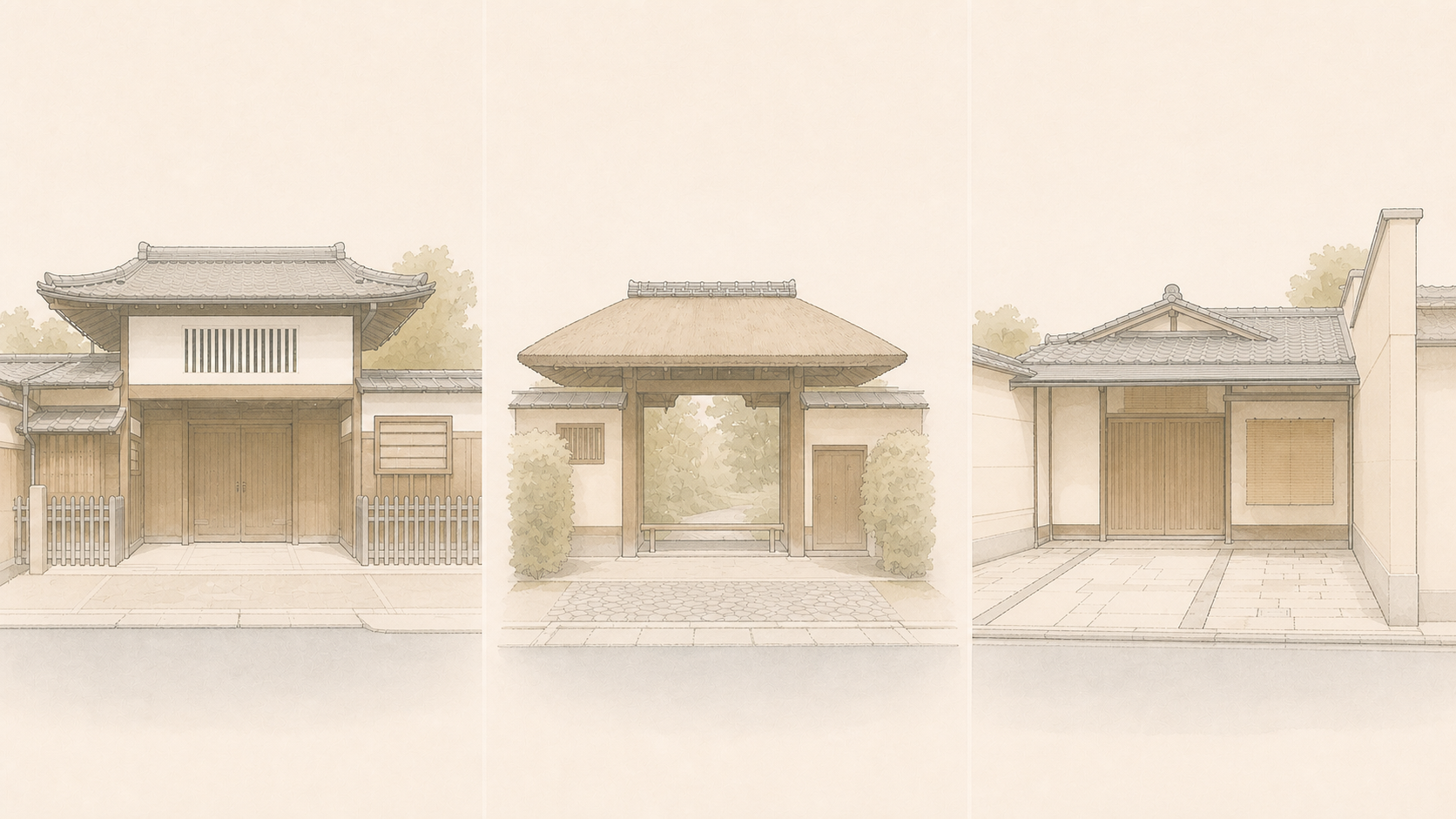
Omotesenke, Urasenke and Mushakōji Senke are three houses with a shared line of succession through Rikyū, Shōan and Sōtan. Three of Sōtan’s sons entered the service of domain lords as tea practitioners and established separate households in Kyoto. How did the houses branch out from Rikyū’s tea, and what do they have in common or pass on in different forms today?
How the Three Houses Began with Sōtan’s Sons
The lineage of the three Sen houses, known as the Sansenke, runs from Sen no Rikyū to Shōan Sōjun and then Genpaku Sōtan. After Rikyū’s death, Shōan returned to Kyoto. He and his son Sōtan re-established the Sen house.
Sōtan had four sons. The eldest, Kan’ō Sōsetsu, left the household. The second, Ichiō Sōshu, the third, Kōshin Sōsa, and the fourth, Sensō Sōshitsu, went on to establish the three houses.
All three count from before the division. Rikyū is the first generation, Shōan the second and Sōtan the third. Each of the three brothers is counted as the fourth generation of his house. Since Kōshin, the Omotesenke head has taken the name Sen Sōsa. Kōshin is the personal sobriquet of the fourth-generation head. Kōshin Sōsa distinguishes him from the later heads known as Sōsa.
Kōshin Sōsa succeeded to the headship of the Sen house and inherited Fushin’an. Sensō Sōshitsu inherited Konnichian at Sōtan’s retirement residence. Ichiō Sōshu built Kankyū-an on Mushakōji Street. All three were running households of their own before those houses acquired the names Omotesenke, Urasenke and Mushakōji Senke.
Omotesenke is the main branch of the Sen house. Its position as the main branch is a separate matter from a claim to the transmission of Rikyū’s tea. All three houses trace their tradition through Rikyū, Shōan and Sōtan.
Three Sons in the Service of Different Lords
Sōtan himself avoided entering a lord’s service but helped his sons obtain such positions as tea practitioners. According to Omotesenke’s official account, the third son, Kōshin Sōsa, entered the service of the Kii Tokugawa family in 1642, the nineteenth year of Kan’ei. Four years later he succeeded to the headship and Fushin’an. After him, Omotesenke’s successive heads continued to serve the Kii Tokugawa as tea practitioners until the closing years of the shogunate.
The fourth son, Sensō Sōshitsu, served the Maeda family of Kaga. He brought the potter Ōhi Chōzaemon from Kyoto and instructed the kettle maker Miyazaki Kanchi. Beyond establishing what became Urasenke, Sensō helped makers of tea utensils and their skills take root in Kaga.
The second son, Ichiō Sōshu, first served the Konoe family and later taught tea in the Takamatsu domain in Sanuki. Later Mushakōji Senke heads continued to teach tea to the Takamatsu domain.
In Kii, Kaga and Takamatsu the three served different lords and worked with different circles of students and craftspeople.
What Each Tea House Came to Hold
Fushin’an, Konnichian and Kankyū-an are names of tea rooms. Today those names are also used in connection with the houses’ organisations and places of practice. Omotesenke describes Fushin’an as the name of a tea room and as a designation for the Sen estate and its institutional structure as a whole.
Fushin’an maintains tea rooms and gardens, preserves utensils and historical documents, and transmits the procedures of tea. Konnichian also preserves its rooms, gardens, inherited objects and works of art and craft, and holds tea gatherings, classes and training sessions. At the Kankyū-an premises in Kyoto, rooms including Kankyū-an, Hanpō-an, Kōdō-an and the Sodō range in size and purpose from a small room to a fifteen-mat hall. The school holds gatherings and classes there and produces publications.
All three houses have places to hold gatherings, utensils to use in them, records to consult about the tradition, and people and places to teach the procedures. Each has passed down the means to serve tea to a guest as well as the sequence of movements.
What the Houses Passed On: Records, Procedures, Utensils and Rooms
The houses’ official materials document what was written down, how procedures were taught, what utensils were preserved and when rooms were repaired or rebuilt. The cases here are ones whose circumstances or purpose can be checked in those sources.
Kōshin Sōsa wrote down what his father Sōtan had told him about utensils, tea procedures, etiquette, rooms and gardens in the Kōshingegaki. Its colophon says he wrote it for his successor Sōha to read. The official source gives us an instance in which the purpose of making the record is known.
In the eighteenth century, Joshinsai Sōsa, the seventh-generation head of Omotesenke, and Ittō Sōshitsu, the eighth-generation head of Urasenke, established the Shichijishiki together. The seven exercises gave their growing numbers of students a way to practise. The set was worked out jointly by the heads of two houses.
At the Kyoto Exposition in 1872, the fifth year of Meiji, a procedure devised by the eleventh-generation Urasenke head, Gengensai, was demonstrated to serve tea to foreign visitors. The official account describes this use of chairs and a table, called ryūrei, as a form adapted to increasingly Western ways of living.
Mushakōji Senke’s Kōdō-an began as a twelve-mat tea room built by the seventh-generation head, Jikisai, in 1774, the third year of An’ei. It was rebuilt with fifteen mats after the Great Tenmei Fire. It burned again, and the twelfth-generation head, Yukōsai, rebuilt the present Kōdō-an in 1940, the fifteenth year of Shōwa. Kankyū-an describes the fifteen-mat hall as a space that can accommodate large groups of practitioners.
Keeping records, developing exercises and procedures, and maintaining buildings have been work shared by all three houses. These cases show what that work looked like at particular moments in their histories.
What the Houses Share and Where They Differ Today
The three houses share a lineage and a system of hereditary headship. Differences can also be seen in practice and in the tea served today. The upper half of the table concerns the lineage and formation of the houses. The lower half gives representative examples a guest or student might see today.
| Point of Comparison | Omotesenke | Urasenke | Mushakōji Senke |
|---|---|---|---|
| Son of Sōtan | Third son, Kōshin Sōsa | Fourth son, Sensō Sōshitsu | Second son, Ichiō Sōshu |
| Seat of the House | Fushin’an | Konnichian | Kankyū-an |
| Name Taken by Successive Heads | Sen Sōsa | Sen Sōshitsu | Sen Sōshu |
| Principal Early Patrons | Kii Tokugawa family | Kaga Maeda family | Konoe family and Takamatsu domain in Sanuki |
| Bamboo Used for Whisks | Smoke-darkened bamboo | Pale bamboo | Purple or black bamboo |
| Whisk Tips | Curve inwards | Curve inwards | Straight through to the tips |
| Froth on Thin Tea | Some froth, usually leaving part of the surface bare | A tendency to whisk up plenty of fine froth | A tendency to keep froth to a minimum |
| Representative Fukusa Colours | Purple for men, vermilion for women | Purple for men, red for women | Purple for men, vermilion for women |
Whisks, thin tea and fukusa vary according to the procedure or implements in use. The colours in the table are typical examples of plain cloths used for handling utensils in introductory practice. Preferences, purpose and instruction at a particular place of practice can lead to different choices.
The sources consulted do not directly connect the use of smoke-darkened, pale, purple or black bamboo, or the froth on thin tea, to a particular lord’s household or event. The Kōshingegaki, ryūrei and Kōdō-an are specific cases from the houses’ histories. They do not establish the causes of present-day differences in whisks or cloths.
Closing | A Shared Lineage, Visible Differences
Omotesenke, Urasenke and Mushakōji Senke share a lineage through Rikyū, Shōan and Sōtan. They took shape as three of Sōtan’s sons established their respective houses. Today we can see differences in the whisk bamboo, the shape of the tips, the froth on thin tea and the colour of the fukusa. The sources do not establish when those differences became customary or why.
Look at where the differences appear. The whisk is in the hand that makes the tea. The fukusa is in the gesture that cleanses a utensil. The froth stays on the surface of the thin tea served to the guest. They occupy separate rows in a table, but a single sequence of tea preparation brings them into view.
I read the differences among the three houses in the way the utensils are handled and the way the body moves each time someone practises. Rikyū’s tea has been passed down in forms that the three houses still enact: taking up the whisk, using the cloth and serving a bowl of tea to a guest.
References
- Omotesenke Fushin’an, “About Omotesenke”
- Fushin’an Foundation
- Omotesenke Fushin’an, “From Kōshin Sōsa’s Writings on Tea: Written for Sōha to Read”
- Omotesenke Fushin’an, “Service to the Kii Tokugawa Family”
- Omotesenke Fushin’an, “The Formation of the Three Sen Houses”
- Urasenke, “The Generations of Urasenke”
- Urasenke, “About Urasenke”
- Konnichian Foundation
- Urasenke, “The 350th Memorial Service for Kakuhō Myōen, Wife of Sensō Sōshitsu”
- Mushakōji Senke Kankyū-an, “History of the Sen Family and Kankyū-an, the Three Houses and Their Successive Heads”
- About the Kankyū-an Foundation
- Mushakōji Senke Kankyū-an, “Tea Rooms at the Kyoto Practice Premises”
- City of Kyoto, “Chanoyu in Kyoto”
- Encyclopedia Nipponica, “Tea Whisks”
- Urasenke Tankōkai Youth Division, Hokkaido Block, “Tea Whisks”
- Wahokudō, Tanimura Tango, “Tea Whisks”
- Senkien, “What to Bring to Your First Tea Lessons: Omotesenke”
- Senkien, “What to Bring to Your First Tea Lessons: Urasenke”
- Senkien, “What to Bring to Your First Tea Lessons: Mushakōji Senke”
- All About, “Schools of Tea: How Omotesenke, Urasenke and Mushakōji Senke Differ”
- Yukie Ōya, “The Structure of the Iemoto System and the Transmission of an Art”
 Who Was Sen no Rikyū? The Life of the Man Who Changed Chanoyu
 What Sen no Rikyū Left Behind: Inheriting a Way of Seeing