
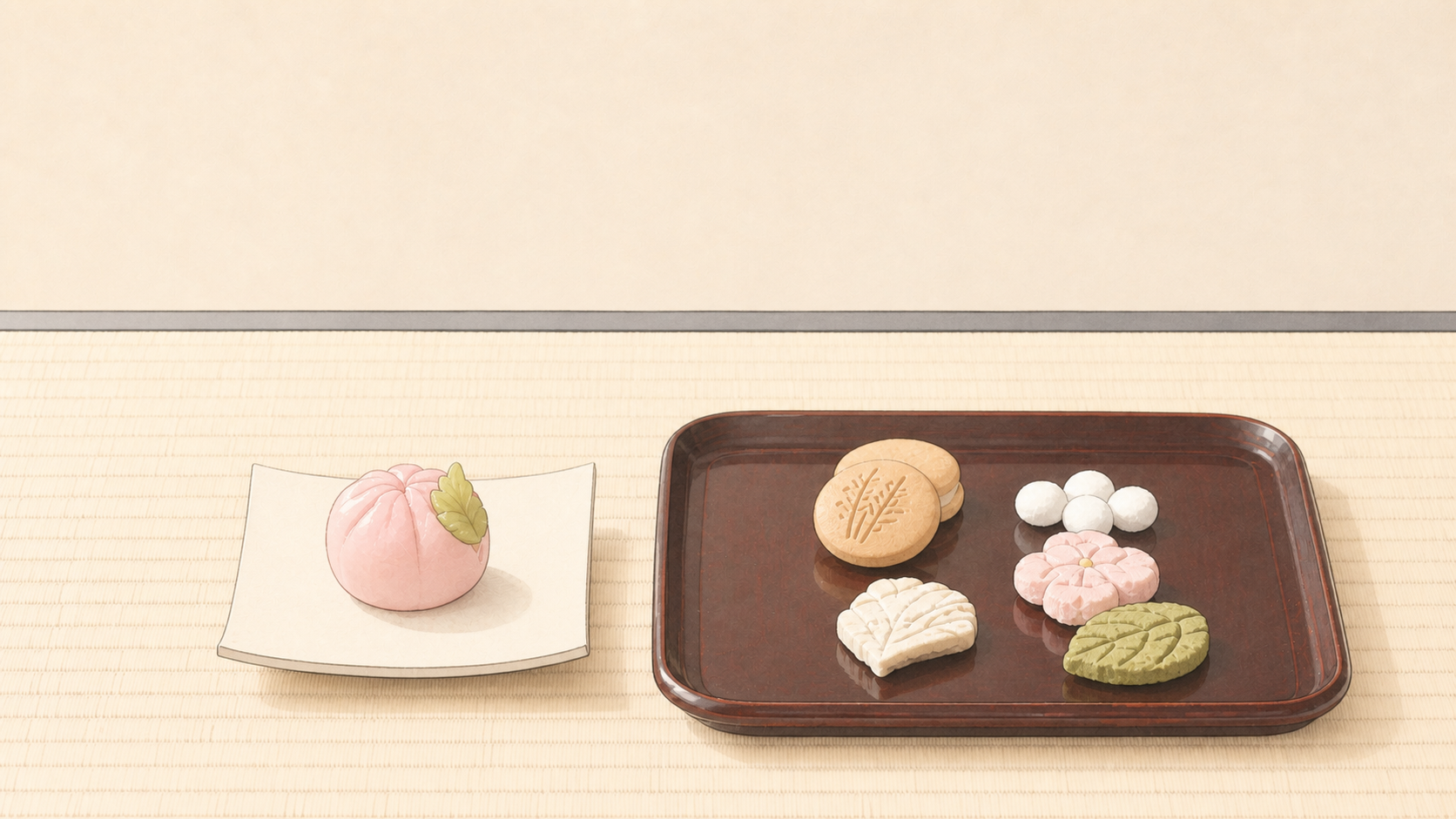
A tea gathering can include omogashi, or main sweets, and higashi, or dry sweets. Moisture and texture tell only part of the difference. The amounts, shapes, and vessels help set the timing before thick or thin tea.
Here we look at how the two kinds of sweet shape the time for each kind of tea. The related articles take a closer look at the names of sweets and the practice of mitate.
The Sweets Have Different Places in the Gathering
Sweets for tea can be broadly divided into main sweets and dry sweets. Omotesenke describes a formal chaji as pairing main sweets with thick tea and dry sweets with thin tea. A main sweet can be substantial and moist, as in nerikiri, konashi, manjū, or other steamed sweets. Dry sweets can include pressed or molded sweets, crackers, and ariheitō sugar candy, and several can be served together. At a gathering for thin tea alone, both kinds might be offered. A simpler gathering may serve one kind of main sweet or dry sweets only.
Consider which tea will be served, in what order, and at what pace. The terms make more sense as part of that choice. Remembering main sweets as “moist” and dry sweets as “dry” alone leaves too much unexplained. The pairing, the vessel, and the time of serving show what each category does in practice.
What the palate needs before thick tea or thin tea can shape the choice of sweet as much as its texture.
Main Sweets Prepare the Palate for Thick Tea
Thick tea uses more matcha and can have a strong aroma and taste. A main sweet with some substance and sweetness prepares the mouth to receive it. At a formal gathering the guests eat the main sweet after the kaiseki meal and before the end of the first half. It is the dessert for the meal and a link to the thick tea served after the intermission. Its shape and name can also tell something about the season.
The size of a bite, softness as it is cut with a kuromoji pick, and sweetness left after swallowing help bring out the bitterness and aroma of the thick tea that follows. The tea and sweet complete one another over time. Even after a meal, the main sweet can shift the palate before thick tea. The serving should feel manageable and still be sweet enough to stand up to the tea.
Moisture and sweetness prepare for the strong umami and bitterness of thick tea. The amount and temperature can take account of how fast the sweet is eaten and how much of its flavor will remain when tea is served.
Dry Sweets Leave Room for Thin Tea
Thin tea often gives conversation room to loosen after thick tea. Dry sweets are small, easy to pick up, and relatively quick to disappear in the mouth. A confectioner writing for Omotesenke describes the importance of stopping short of doing too much. The sweet should leave room for conversation and for talking about the utensils.
Increasing the detail may make the confection look more accomplished and still take too much attention away from the gathering. A small, spare sweet can leave room for thin tea and conversation. Its effect has to fit what is around it. The confectioner describes how, over time, people chose the sizes and forms that worked for tea. Makers, guests, and practitioners have all had a part in that process.
A light texture can leave the fragrance and foam of thin tea perceptible. When two sweets are served, different colors and textures can give each bite room to lead back to the tea.
The Vessel Changes How Guests Take a Sweet
At a formal gathering, main sweets are presented in stacked fuchidaka boxes. A guest uses a kuromoji to move a sweet onto a sheet of kaishi. For thin tea, a lacquered or ceramic jikirō can hold the main sweets, depending on the season. A simpler arrangement can put one sweet on each plate. Different dry sweets may share a tray. The vessel gives guests cues about where and how many to take, and how to pass the rest on.
Stacked fuchidaka separate portions. A tray of dry sweets leaves some choice. The same sweet can ask for a different movement and give the gathering a different pace when the vessel changes. Guests take their share and pass the vessel on. An arrangement that is easy to take from helps the guests divide the sweets without disturbing what is left.
The Sweet Can Carry Part of the Season
Both kinds can suggest a season through shape, color, or name. Repeat one design in the flowers, scroll, bowl, and sweet and the gathering can begin to overexplain itself. If the sweet shows a flower, the vessel can echo only a color. If the name suggests rain, the sweet can have a shape other than a literal drop. The host decides how much the sweet needs to convey alongside the other things in the room.
The distance between elements can do more for the season than the number of motifs. The confectioner can stop before the design is overworked, and the host can leave room in the arrangement. A guest may see the same color and shape as a different scene after hearing the sweet’s name. The word can bring a season to mind.
Look at the Order in Which Sweets Are Eaten
In a shop the sweet is seen by itself. In a gathering you take it, look at it, hear its name, cut it, eat it, and drink the tea. A main sweet can come before the intermission and connect with thick tea afterward. A dry sweet sits close to the preparation of thin tea and conversation. A photograph gives you the form, while being in the room shows the size on the kaishi, where the fingers or pick meet it, and how it disappears in the mouth.
Look at what the sweetness does to the next tea and what the vessel asks of the guest’s hands. Eating the sweet first does more than temper the bitterness of matcha. The succession of sweetness and bitterness gives each a shape of taste it would not have alone.
Which tea comes next, which vessel carries the sweet, and how is it shared? The order and the movements of the guests give the taste a role. The design includes the full time in which something is tasted.
Closing | Sweetness Sets the Time Before a Bowl
After the meal, a substantial main sweet prepares the palate for thick tea on the other side of the intermission. A small, light dry sweet makes room for thin tea, conversation, and a hint of season. Fuchidaka, a jikirō, and a tray guide how guests take the sweets and how quickly the gathering moves. When choosing a sweet, consider which tea will follow, what it will be served in, and how long its flavor should stay.
Sweetness has a role of its own in making time for the tea to come through. Once the sweet is gone, there is still space in its vessel and a memory of its name. Conveying a season through something that is eaten lets the scene stay with the guests as an experience. The two kinds of sweet differ in what they do in a gathering as well as in how they taste by themselves.
 How a Sweet’s Name Suggests a Scene Before the First Taste
 Why Do Sweets for Tea Suggest the Season Indirectly?