
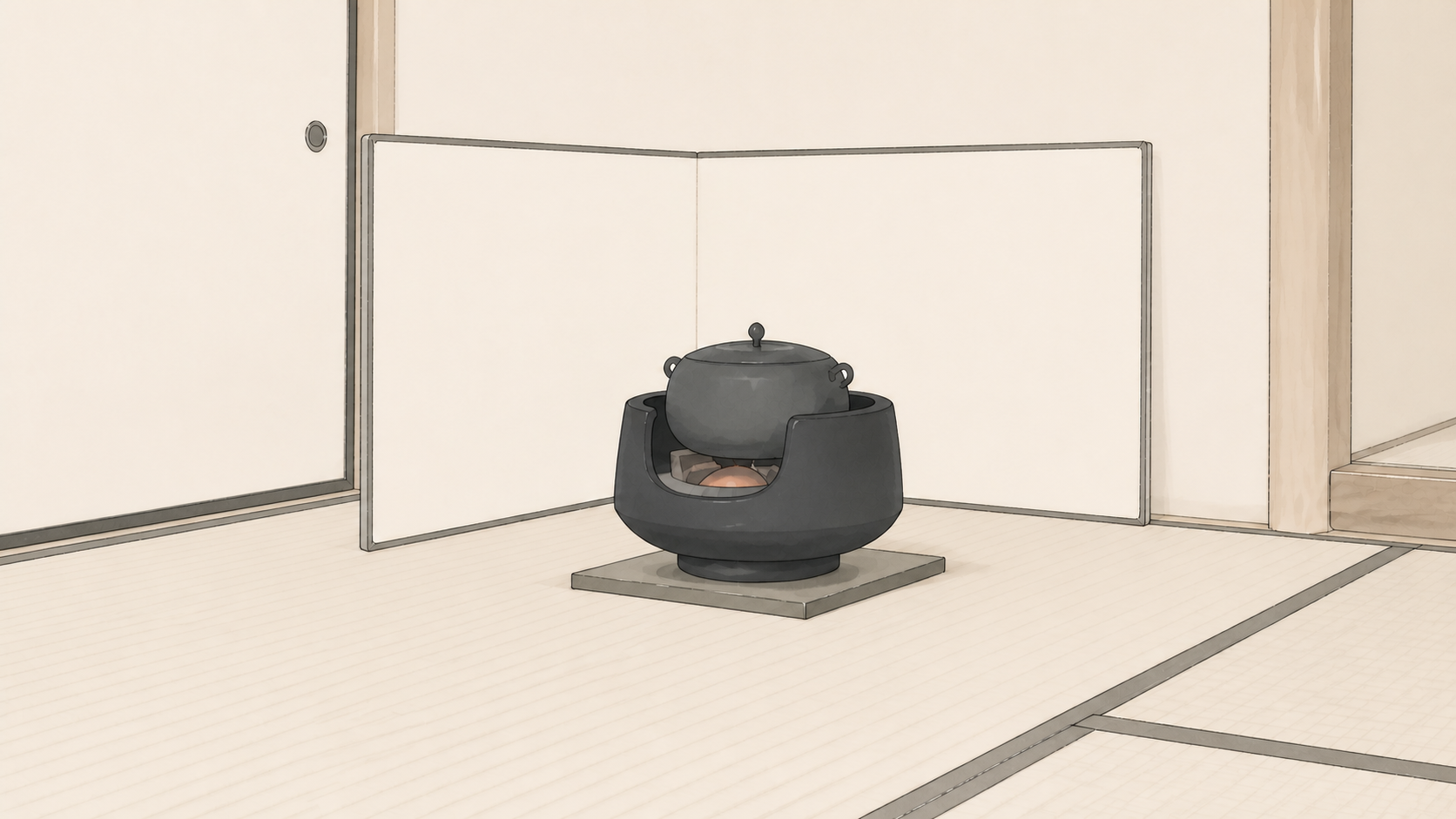
In October, near the end of the portable brazier season, the brazier moves closer to the center of the mat where tea is prepared. In nakaoki, bringing the fire closer to guests and setting the water farther away makes the deepening of autumn perceptible. What does a shift of a few tens of centimeters do to the distance between fire and water?
What Is Nakaoki?
Nakaoki is an autumn arrangement in which the portable furo brazier is set closer to the center of the mat used for tea preparation. During the brazier season, the fire usually sits a little farther from the guests. As the heat of summer recedes and before the sunken hearth opens, the brazier is moved so the guests can feel the fire nearer.
Details of the preparation vary with the school and utensils. The central change is one of placement, using the brazier and water jar already in the room. Even with the same room and tatami, a shift in the center can change the guest’s impression.
Moving the existing brazier by a few tens of centimeters changes how fire, water, guests, and host relate to one another. The center of gravity on the mat and the way the body faces change with it. The season can be expressed by arrangement alone.
Watch the host and the effect becomes clearer. The direction of a reach, the angle of the body, and the path of the eyes between kettle and water jar differ from those of the usual brazier preparation. The placement changes what the guest sees and asks the host to adjust movements the body knows.
Why the Position Changes in October
As the brazier season that begins in May approaches summer, it is more comfortable for the fire to feel farther away. By October, mornings and evenings are cooler and the warmth is welcome. Until the hearth is opened in November, the portable brazier remains in use.
Nakaoki belongs to that transition. It gives form to the weather between summer and winter. Seasonal details can be carried by cherry blossoms or maple leaves, but a difference of a few tens of centimeters can also register a change the body feels.
Bringing fire closer and setting water farther away involves imagining how the guest feels the room. Where do they sit, and where might they feel the chill? Here consideration is expressed in the placement of the objects.
What interests me is the wish to keep the fire from being far away. On a suddenly cold day, moving the fire already in the room a little nearer to someone can change how they feel. That small adjustment gives the arrangement much of its restraint.
Fire Closer, Water Farther Away
Nakaoki is often explained as bringing the fire closer to the guest and moving the water farther away. Water, which gave a sense of coolness in hot weather, recedes. Fire, which carries warmth, comes forward. Where the emphasis falls changes with the season.
The fire need not grow larger or direct heat at the guests. Its source comes a little nearer in their field of view, and the steam and sound of the kettle can feel closer. Hospitality can begin with a placement that helps someone notice what is already there.
I see nakaoki as a small example of responsive design in a tea room. The size of the room stays the same, but the arrangement can respond to a change of season. Its relationships can be adjusted for this place and these guests.
As the brazier moves toward the center, the fire comes nearer and the water jar moves toward the host’s service side. The directions in which the host reaches for fire and water also change. The movements register the passage into autumn as well as the temperature does.
A New Center on the Tatami
The tatami gives people cues about where to put utensils, where the host sits, and how guests move. Bringing the brazier toward the center changes the open space on the mat. A tall, narrow water jar might go to the left of the brazier, making a new arrangement within the same space.
The tatami works as a grid for judging distance. Change one reference point, and the positions around it change with it. Nakaoki gives the room a different season by moving a reference point in the layout.
There are conventions that depend on the school and size of the room, including the reason some schools avoid nakaoki in a small tea room. The established form makes the move intelligible and still leaves room to respond to the people present.
When the brazier comes near the center, a part of the mat that was open in summer becomes a place for fire. The same utensils leave different spaces around them, and the room’s weight shifts toward winter.
The Host Has to Move Differently Too
The host’s orientation and reach change when the utensils move. Rather than reaching for the usual spot, the host attends to the distance between the brazier, water jar, and kensui, or waste-water vessel. The guest can see how the body adjusts as well as what the objects look like at rest.
Arranging the room for a season does more than change how it looks. A small shift interrupts what the body remembers and makes a practiced gesture deliberate again. Nakaoki gives the host a way to experience autumn through practice.
A photograph can tell you that the brazier moved toward the center. At the gathering, the fire’s apparent nearness and the way the water jar recedes depend on where the guest sits. Move the same distance shown in a plan, and from a low seat on the tatami the height of the kettle and nearness of the steam can feel quite different.
Changing the Season with the Same Equipment
Changing seasonal decorations is common in rooms today. Nakaoki can alter the feel of a room by moving the heat source and the water. The placement of functional objects signals the season.
Who will something be brought closer to, and what can be moved farther away? A change of distance can give the same object a different meaning. The effect of a space depends on the intervals between objects and people as much as on how many things are in it.
Look at the narrow interval between the brazier and the water jar. The empty part of the mat changes shape when the utensils move. Too narrow a gap can feel cramped, while too wide a gap can make the two pieces seem unrelated. The season can be felt in the space between them.
Closing | Showing Consideration Through Placement
Nakaoki conveys autumn through the positions of fire and water. Bring the fire a little closer to the guests and move the water away. The center of the tea room and the host’s movements change with that small adjustment.
Imagining what someone else’s body might find comfortable can be a way of showing consideration. Nakaoki puts that quiet choice of distance in view.
October temperatures vary from year to year and place to place. The placement takes on meaning when the host imagines that day’s breeze and how the guests will feel. Paying attention both to the established form and to the actual weather keeps the arrangement alive.
References
- Urasenke, Questions and Answers with the Grand Master
- Urasenke Chadō Handbook, supervised by Sen Sōshitsu, Yama-kei Publishers
 Why Switch Between the Ro and Furo? How Moving the Fire Changes the Tea Room
 Mizuya: The Work Behind the Quiet of a Tea Gathering