
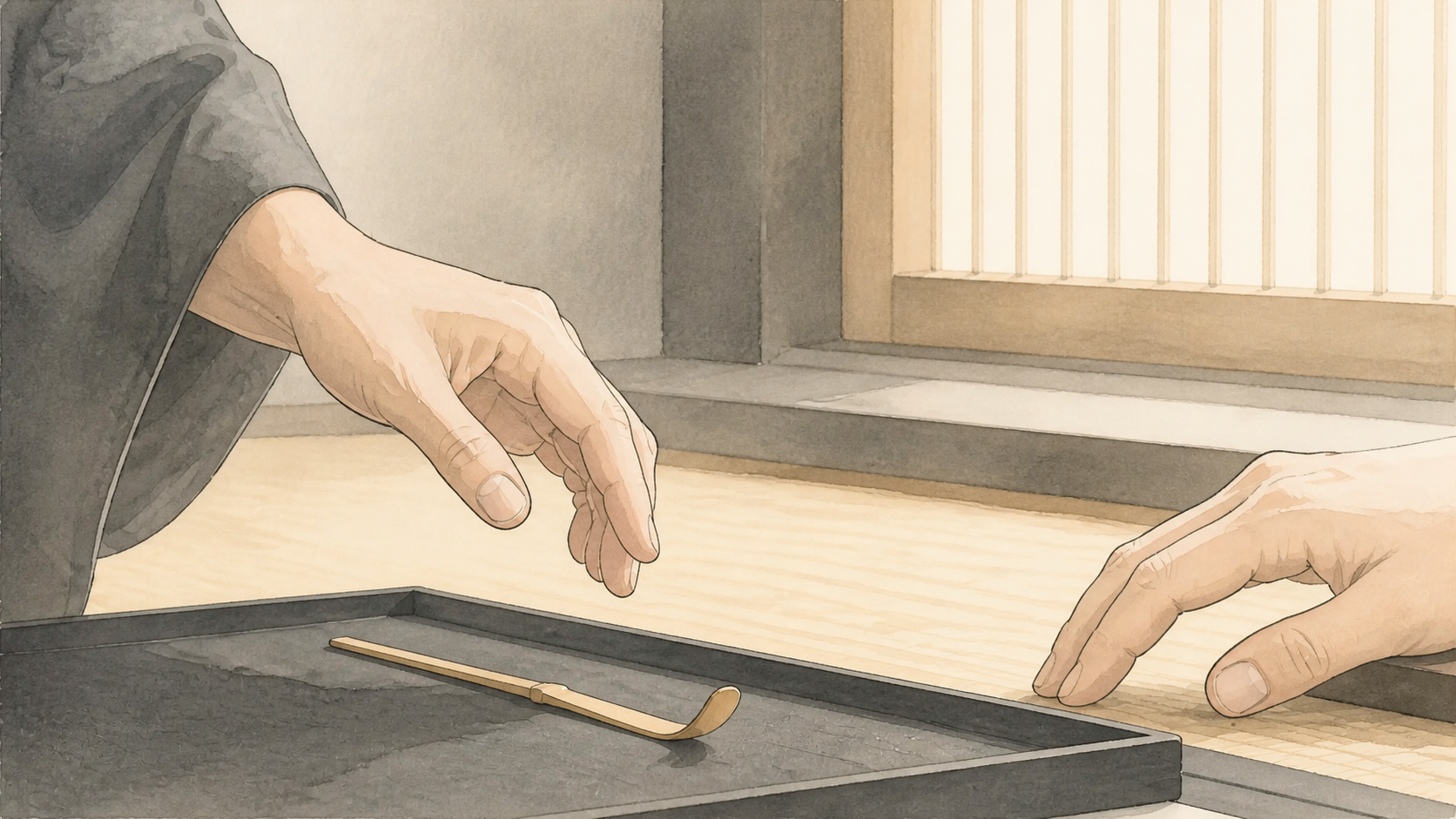
An interval lets one person’s gesture reach another and gives them time to receive what follows. We look at how the gaps between movements, the spaces between things, and the pauses in conversation direct attention toward another person. In a tea gathering, that interval is called ma.
What happens in an interval
When movement stops, it can look as if nothing is happening. That brief stop lets the preceding action register and gives the guest time to receive the next one. The guest anticipates what will follow, the host takes in how the guests are responding, and the tension in the room shifts slightly.
Ma divides events and lets their relationship become meaningful. Like a rest in music, it is silent and still shapes the rhythm of the whole.
Between setting down a utensil, bowing, and offering tea, there is time for the other person to look and receive what is offered.
The interval between gestures includes the guest’s pace
A host can move through the sequence quickly and accurately and still miss what a gathering needs. Notice whether the guest is still looking at a utensil or ready for the next gesture, and let the pace respond.
A long, deliberate pause can feel theatrical. The right pace comes from the other person and the situation.
An interval in space makes distance meaningful
There are distances between utensils, between people and the alcove, and between host and guests. Nearness can bring intimacy or tension. Distance can bring quiet or separation.
Making room is a question of what should be joined and what kept apart. Equal spacing cannot answer that by itself.
A pause makes conversation go both ways
Another explanation offered too soon can cut off a guest’s own observations. Leave a little time after a question and the other person has a chance to find words.
Ma gives the host and the guest a practical way to notice each other’s responses. Pace, distance, and silence help a conversation move in both directions.
An established form makes differences in timing visible
Temae follows a sequence and has established forms. Treating the form only as a constraint makes the interval hard to understand. A shared sequence gives meaning to small differences in speed or stillness.
Skill lies in varying the pace between movements that can proceed without hesitation and moments that call for attention to the guest or utensil. Those changes let the whole sequence breathe.
Schools and settings differ. It helps to look at ma within a particular way of making tea, with its guests, utensils, and purpose, before calling it a universal Japanese aesthetic.
Ma changes in response to the other person
Pausing for a fixed number of seconds cannot ensure that the interval works. The time to move on depends on whether the guest is still studying an object, wants to continue a conversation, or feels tense.
In communication design, information packed in at the sender’s pace leaves little way for the recipient to take part. Time to understand, feel something, and answer can turn a transmission into an exchange.
The pause has no preset length. Expressions and answers change it in the moment. The interval is invisible, but what takes place in it can reveal the care people take with one another.
Slowness and ma are different things
Slower gestures sometimes look composed. Unnecessary slowness can stall the sequence and make a guest aware of the performance.
Ma concerns the relationship between actions. Time takes shape because there are places to proceed, to stop, and to wait for someone.
A pace that changes with what each moment means feels more natural than unvarying deliberation. Ma helps give time its rhythm.
Sound marks the edges of time we cannot see
A whisk touching the bowl, the water in the kettle, the little noise of a utensil being set down: sound marks time in the tea room alongside what people see.
Quiet leaves room for a necessary sound to be heard. When silence follows it, the guest can sense a transition between actions.
As the visible gestures and audible rhythm fall into step, the people in the room share a sense of time. Ma helps bring the senses together.
A pause in conversation can show respect
Answering immediately or explaining without a break may seem kind. It can also take away the time the guest needs to put their own impression into words.
A host who can wait in silence and watch the guest’s gaze and breathing gives room for discovery together, beyond simply offering an explanation.
Communication has a measure beyond the amount of information it conveys. Tea practice shows how the time for hearing and taking something in can be part of what is designed.
The kettle, the whisk touching the bowl, and the little sound of a utensil being set down can signal that an action has ended and show whose turn is next. With less competing for attention, a single sound can mark the boundary between moments without being specially amplified.
People make ma together
A few seconds after someone finishes speaking can change the quality of the next remark. I see that time as room for another person’s thought to reach the group. Fill it with the next words too quickly and the information moves along without anyone thinking more deeply. The appeal of ma in chanoyu lies in what the brief pause does to the action that follows.
Watching temae, you might see the host’s hands seem to stop. The host is still reading the positions of the utensils, while a guest waits for the next movement and settles their posture. The interval gives several people’s attention a chance to come together. What interests me is that coordination, beyond the effect of silence.
Lengthening a pause does not make it elegant. An unnatural silence can leave a guest stranded. A pause has a length suited to the actions around it, the relationship, and the tension in the room. In conversation too, restraint matters alongside a pace at which someone can take in what they hear. An interval allows one moment to lead into the next without forcing the connection.
Notice what goes on while people wait
Look just after the host sets out a bowl, just before a guest begins formal viewing, or when a conversation briefly falls away. The interval receives the preceding action and makes room for the next. Watch that point of contact and timing begins to look like a response to another person, beyond the speed of a prescribed movement.
Conclusion
In chanoyu, a pause lets a gesture reach someone, makes room to read their pace, adjusts the distance between objects and people, and gives a conversation space for a reply. A stop in movement is also a chance to wait for a response before going on. An established form gives those relationships a starting point. The guests’ responses, the handling of utensils, and the rhythm of conversation shape what happens from there.
To notice ma, remember where your attention went rather than counting seconds. While waiting for a bowl, did you hear the kettle, catch someone’s breathing, or start looking for the next thing to say? The quality of the interval changes with the attention people give it.
 Is the Empty Space in a Tea Room the Same as Negative Space in Graphic Design?
 What Does a Kettle Tell Us? Listening to the Water in a Tea Gathering