
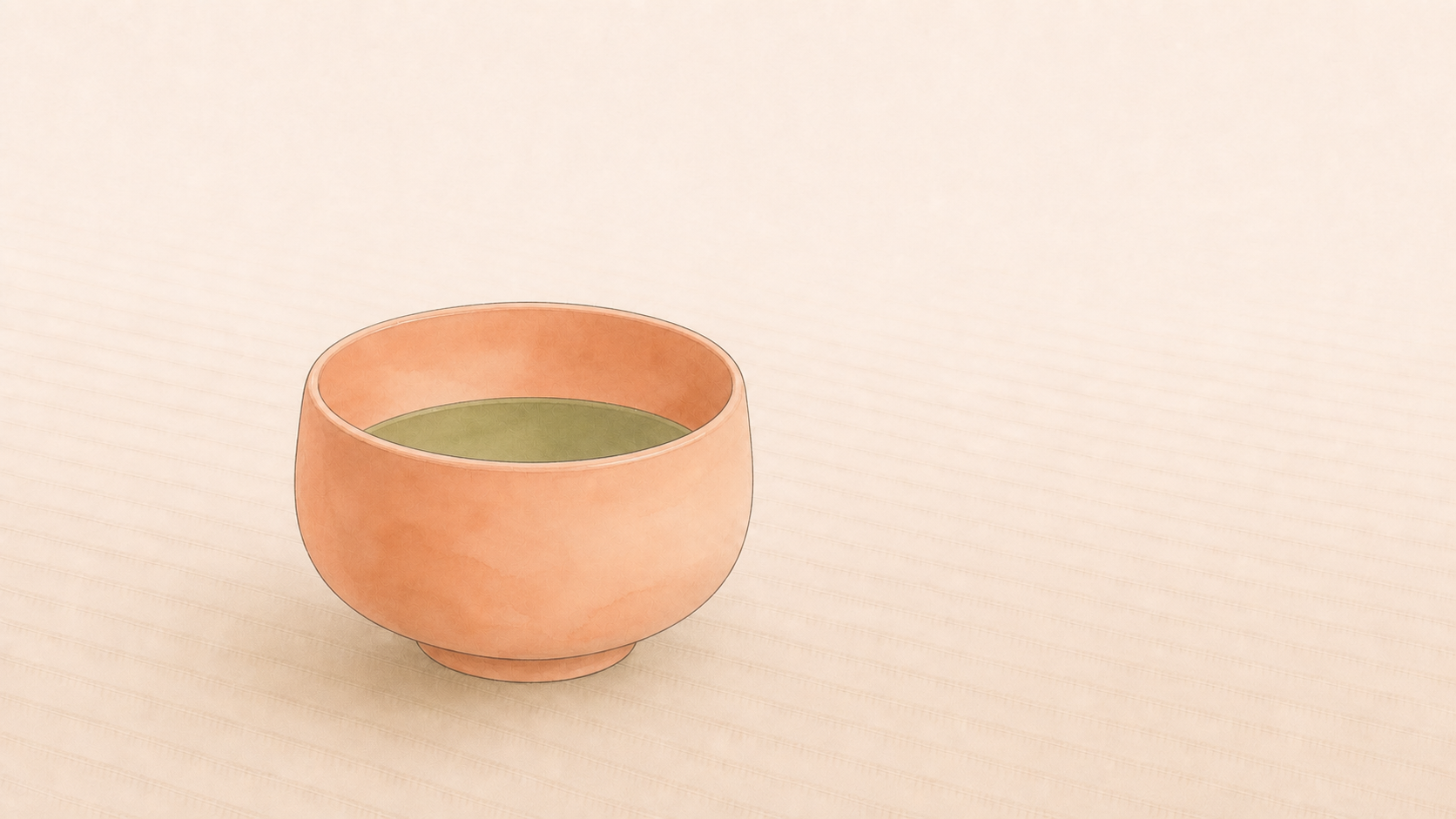
In koicha, or thick tea, one bowl brings together the order in which the guests drink, the host’s work, the quality and standing of the tea, and the concentration in the room. That shared experience is where thick tea differs most from thin tea.
What Makes Koicha Different from Usucha
Tea so dark it is nearly black moves slowly across the bottom of the bowl. Unlike the light foam on usucha, thin tea, koicha has a weight to it. It comes from the taste, the time spent preparing the tea, and the way the people in the room share it.
The matcha for thick and thin tea is made by the same process. The main differences are how much tea and water the host uses, whether the tea is worked into a thick mixture or whisked as thin tea, and the role each plays in the gathering.
What makes koicha central to a formal tea gathering is what happens around the bowl. It gives the host and guests a single point of attention and a stretch of time to share.
The difference goes beyond the strength of the matcha.
There is resistance as the host works it, a different pace when the bowl turns, a thickness in the mouth, and a lingering taste. Even a small amount is dense. The sweet, the vessel, and the order in which the guests drink are part of the preparation for that moment.
How Sharing a Bowl Makes the Guests’ Relationships Visible
In a traditional way of serving koicha, the guests drink from the same bowl, starting with the principal guest. The way it passes from hand to hand makes their order and relationships visible.
Practice varies with the school, the host’s plans for the gathering, and considerations of hygiene. The question here is what the act of sharing one bowl has come to express.
The Tea’s Standing and Name Are Part of the Experience
The host chooses a tea that suits the gathering. Its name, the tea merchant, the tastes it reflects, and where it comes from help show the care with which the host prepared the occasion.
Ease of drinking alone tells us little about what suits a formal occasion. Price alone tells us just as little. The tea’s background comes to matter through its relationship to the guests, the season, the sweet, and the bowl.
When the bowl passes in order, each guest can see how the person before them turned it, how much tea they left, and how they passed it on. Sharing here means receiving the effect of someone else’s gesture and making a gesture the next person will receive. The moving bowl makes that relationship visible.
Reading the Tea as You Work It
A fixed number of strokes will produce different results. The host feels the condition of the matcha, the temperature of the water, and the shape of the bowl while bringing the tea to a cohesive, glossy consistency.
The host feels resistance and adjusts pressure and speed in response. The hand and the tea shape the movement together.
The Main Sweet Comes First
The main sweet served before koicha prepares the palate for the concentrated savor and astringency to come as well as bringing sweetness.
The ingredients, name, and serving vessel of the sweet matter, as does the time guests have to finish it. The experience of the bowl begins before it is brought in.
The Weight of the Bowl Carries the Room’s Concentration Into the Hand
A koicha bowl can be admired, and it also passes through several hands. Its weight, rim, interior, and the way its glaze sets off the tea affect how quickly a guest drinks and how they hold themselves.
A celebrated bowl has a provenance and a feel in the hand. Both matter because this is where a utensil’s history meets the body of the person using it.
The Room Holds a Great Deal of Information in Its Quiet
A quiet room still holds the tea, sweet, utensils, order of the guests, and their heightened attention. They are arranged to keep the bowl in focus.
That shared direction of attention is what gives the room its quiet. It brings several senses to one center without requiring the surrounding elements to disappear.
What Sharing a Bowl Can Teach Us Today
Using the same thing at the same time is only part of a shared experience. Someone receives it first, someone receives it next, and there is a point at which everyone has to come together in time.
Koicha offers a way to think about how a particular experience can change the relationships between the people sharing it.
Where to Start When Watching Koicha
Start with where the bowl is set down and whom it passes between. Then find out about the tea’s name, the bowl, and the main sweet. Those details give depth to the place koicha holds in the gathering.
A newcomer can sense the order of the guests, the host’s concentration, and the care with which the bowl is handled. If a gesture is unfamiliar, ask what it is there to protect.
Taste, formality, history, and the body all matter together in one bowl. Seeing them at work at the same time is a way in to reading chanoyu as design.
Making Time to Share One Bowl
A photograph of koicha shows the consistency and color of a thick drink. Watch the time from the principal guest receiving the bowl to the next guest taking it and another part of the gathering comes into view. Nobody can drink entirely at their own pace. That constraint makes the presence of the other guests felt in the body.
There is no need to idealize this as a ritual of intimacy. Schools differ, and decisions about hygiene can change how thick tea is served. The traditional shared bowl still lets us ask what happens when everyone receives tea from one center. Each person’s actions change because other people are there.
A well-made presentation does not by itself bring a room together. Who opens the conversation, where there is a pause, and which words the room takes in together can change the meaning of the same proposal. I see design in the way koicha uses objects and order to form relationships.
Imagine one gathering with a particular tea, a bowl with a history, a main sweet, and a set of guests. An expensive tea or a celebrated bowl has a place, but that place depends on what else is in the room. The host’s judgment shows in how those things, with all their history, become an experience for the guests who are here today.
Watching the Bowl Pass
Even with three close friends as guests, the choice of principal guest affects how the bowl travels. As it passes in order, the next guest watches how the previous one drank and prepares to make their own movement. That adjustment is made person to person. The form gives each guest a way to notice the others.
A photograph of koicha can exaggerate its weight by making the tea look pitch dark or unnaturally thick. I would look instead for the natural gloss and consistency of the prepared tea, the inside of the bowl, and the light in a gathering on tatami. Those details show the density of the tea in context.
It would also be misleading to present koicha as an ordeal of bitterness. There is savor, aroma, temperature, and texture to take in, along with the history and formality. The sensory experience is part of what makes this a living practice.
Guests can share one bowl and come away with different impressions. For a while, each person takes on something of the others’ pace. That kind of relationship, constraints included, raises a question for a society organized around individual experiences.
Conclusion
Koicha brings together the tea’s standing, the host’s work, the main sweet, the bowl, and the order of the guests. The form makes it possible to share a stretch of time. Its design becomes visible in what the gestures do to the relationships in the room.
The formal bowl gives the guests a particular way to share that time. Follow the density of the tea, the movement of the bowl, and the order of the guests as one sequence, and the purpose of using one bowl becomes clearer.
The next time you drink koicha, notice the pace of the bowl between guests as well as your own sip.
 Main Sweets and Dry Sweets: Sweetness in the Time of Thick and Thin Tea
 Why Does a Small Chaire Carry So Much History? Tea Caddies, Pouches, and Thick Tea