
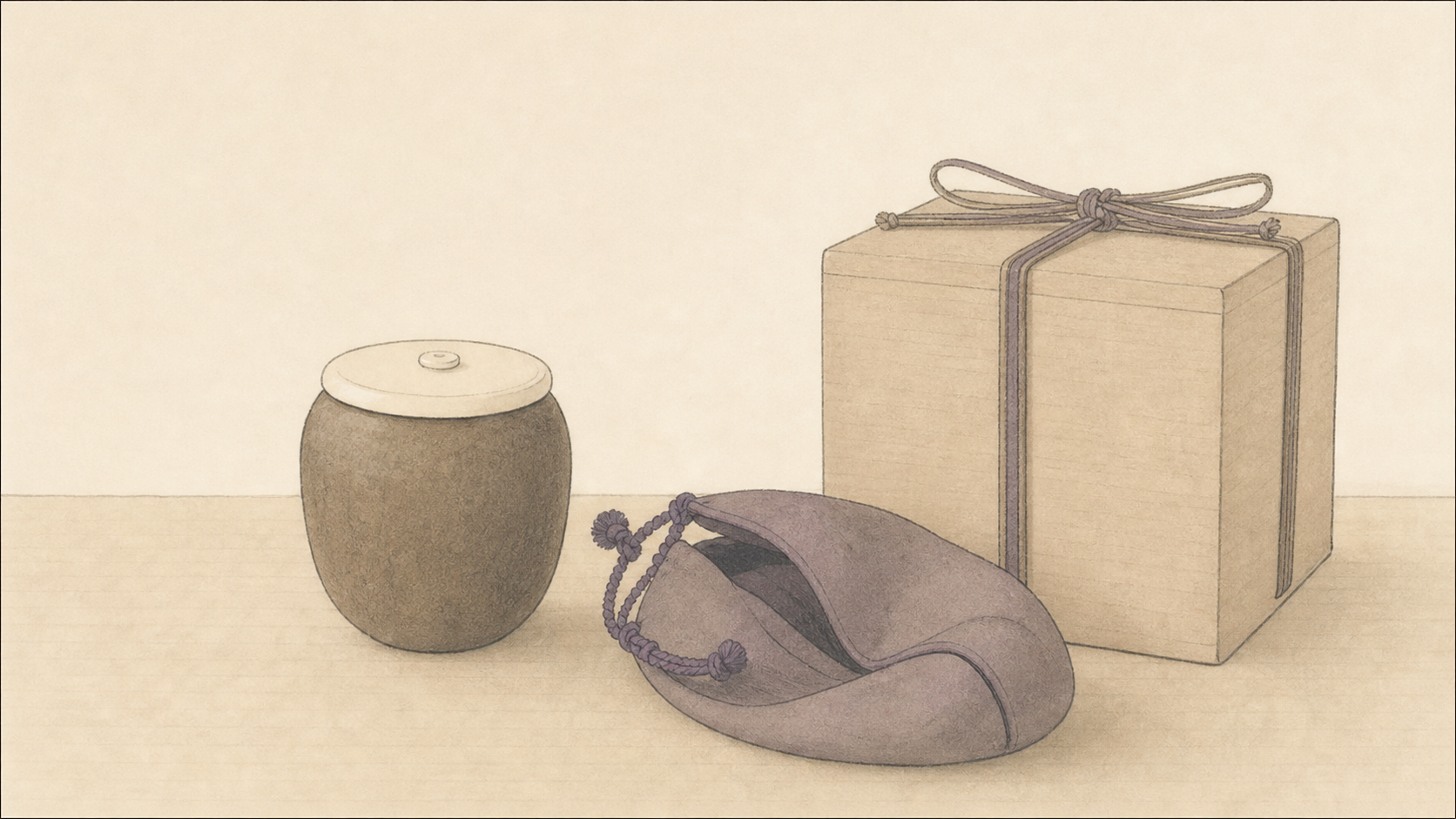
A chaire holds the matcha for thick tea. Its pouch, lid, box, name, and history all accompany it into the gathering. To understand why so much surrounds such a small vessel, begin with the tea it holds.
The Chaire Holds Matcha for Thick Tea
Seen alone, a chaire is a small ceramic container. Watch it come out of its pouch, have its lid lifted, and give up the matcha for thick tea, and a longer stretch of time comes into view. The things that protect the caddy also help convey its meaning. Its value extends beyond the ceramic body.
The chaire holds matcha intended for koicha, or thick tea. Its difference from a natsume or another thin-tea caddy involves its role and the formality of the gathering as well as its shape.
Its size gives little indication of the care with which it is handled or the history it can carry into the central part of a gathering.
The Shifuku Comes Between Hand and Vessel
A chaire may have a shifuku, a cloth pouch whose colors, pattern, and origin affect how we see the caddy. The fabric also protects it.
Covering, tying, and untying put a little time and distance between the hand and the vessel. Those movements are part of the encounter.
An Ivory Lid Joins Two Materials
A chaire lid uses a material different from the body. The fit at the mouth is precise. The narrow join is where protecting the contents and handling the vessel meet.
As with a mizusashi water vessel, different materials can share the work while remaining separate. I see this as a way of designing the relationship between the parts.
The Accompanying Objects Carry the Provenance
Boxes, pouches, and inscriptions can make up the shidai, or accompanying objects and documents. They help tell who recognized a chaire and how it passed from one person to the next.
The relationships that have accumulated around the caddy shape how we see it today. Its history matters alongside what we can see and feel in the object itself.
A Small Opening Slows the Hand
Scooping matcha through the mouth calls for care. The host has to handle the tea properly and avoid damaging the edge. The opening changes the speed and force of the hand.
What interests me about that care is what it protects. The vessel’s formal standing and the work of the body come together in the same movement.
Why a Celebrated Chaire Became a Meibutsu
Appearance tells us only part of the value of a caddy regarded as a meibutsu, or celebrated object. Its period, owners, mentions in tea records, and box inscriptions can all matter.
A newcomer can start with any of those details. Each gives the eye something new to notice.
What Provenance Tells Us That a Brand Cannot
A celebrated chaire can carry a name, a list of owners, box inscriptions, and pouches. The prestige of the name tells us who esteemed it. Provenance also documents what someone did to protect it, how it was used, and how it reached the next owner.
The record extends beyond the ceramic surface. Box, pouch, cord, and lid can tell us about choices made by people who handled the caddy. Looking at what encloses it and the order in which it is revealed brings us closer to that history.
A modern brand can convey value through a logo or a price. The standing of a chaire takes shape through years of use, judgment, and passing it from hand to hand. Both offer a reason to consider what happens outside the object itself. The caddy reaches the hand through a box and pouch and appears only after a knot is untied. That delay protects a fragile thing, helps convey its provenance, and draws the viewer’s attention in a little at a time.
Reading the Chaire Through Its Pouch and Accompanying Objects
A shifuku protects a caddy. The color and pattern, the way the cord is tied, and the softness in the hand also prepare you to touch the hard ceramic within. Bringing the materials into view one after the other gives the encounter its own pace.
The caddy comes out of the box. The cord is untied, the mouth of the pouch is opened, and only then does the chaire appear. Bypass those steps and you see the vessel earlier, with less sense of how it has been protected. The way the covering comes off shows that these objects are a means of passing the vessel on.
Sources can give us names, dimensions, origins, and rules for the chaire. After checking those facts, I ask what the rules do to the speed of a hand or the distance between people. Historical details and editorial interpretation each have their place. Together they can help us see how a form or practice fits the objects, people, seasons, and time around it, and give us something to notice in daily life.
The Time Gathered Around a Small Vessel
A chaire takes up little space, but it can bring a long history into a gathering. Its present use for thick tea, the skills with which it was fired, changes of ownership, and the times when pouches and boxes were added can all come into view together. Its smallness brings these different periods within close reach.
Follow the movement from the outside in without looking straight past the wrapping. What does the hand touch first? Where does it pause? When does the vessel appear? The time spent waiting for something to come into view is already part of looking at it.
The next time you see a chaire, start with what surrounds it. Look at the pouch and knot, the lid, the box, and the inscriptions. Then return to the hand that scoops out the matcha.
The layers around the vessel help make one experience. You can see how small it is and how much it carries at the same time.
Labels like “Japanese” and “minimal” can cover up the details. Look first at the marks on the material, where the hand touches it, the space around it, and the sequence of movements. Compare those first impressions with historical sources.
Conclusion
The chaire holds matcha for thick tea and is accompanied by a pouch, lid, box, inscriptions, a name, and a provenance. These things record relationships between the vessel and people over time. Look at its history and standing, then return to its handling. I see a design for passing on value through what surrounds the vessel as well as through the vessel itself.
The role in keeping matcha for thick tea, the time spent undoing the pouch, the join between lid and mouth, and the box and provenance come into view in sequence. Each draws the guests’ attention a little closer. Together, vessel, textile, and records lead the eye back to the form of the actual object.
 The Three Celebrated Tea Caddies: Hatsuhana, Nitta and Narashiba