
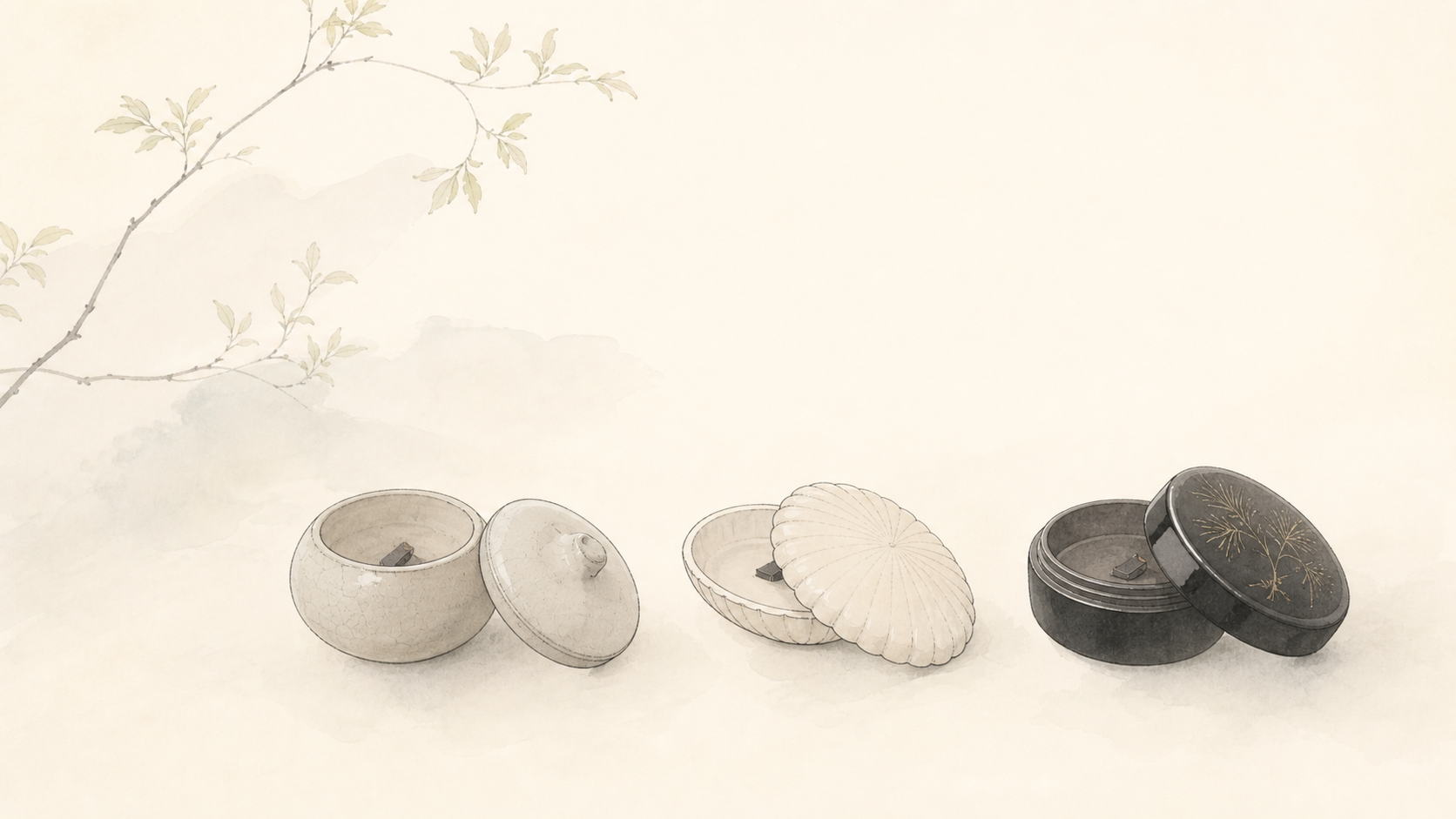
A kōgō is a small container for incense. Its material and shape connect the season, the kind of fire, the charcoal procedure, and what the host wants to bring out in a gathering. It starts with a vessel small enough to hold in the palm.
The kōgō is a small container for incense
With the lid shut, the incense is barely apparent. Yet the small vessel can make a strong impression at a gathering. Its shape is visible. Its scent is not. The kōgō sits at that boundary.
The kōgō stores the incense and is handled in procedures such as laying the charcoal. The vessel is small, but its material and the other utensils chosen with it depend on the season, the incense, and whether the host is using a ro, the sunken hearth, or a furo, the portable brazier.
Its use is practical, and it can also concentrate a gathering’s theme in a single object.
After looking at a kōgō, you may remember more than the shape. Scent, the sound of the charcoal, and a brief exchange among guests can stay together in the memory. I see that combined impression as part of the design.
The hearth and the brazier call for different materials
A common arrangement is kneaded incense in a ceramic container in the hearth season, and fragrant wood in a plain wooden or lacquered container in the brazier season. Schools and procedures vary.
The point of the material is to bring different kinds of incense, fire, seasons, and utensils into a workable relationship. That relationship gives the categories their meaning.
Giving an invisible scent a shape
Scent spreads into the room without retaining a shape. The kōgō gives this invisible experience an outline that the hand can touch.
Before the lid opens, the shape or design lets the guest imagine the season and the scent. The eye gives the nose a way in.
A seasonal story on a small surface
Some containers take the shape of an animal, plant, or familiar object. Others are painted. A small form can convey the theme of a gathering in very little space.
The more recognizable the shape, the more care is needed to avoid duplicating its effect elsewhere. If the kōgō carries the theme, the other objects can give it room.
Formal viewing brings the object close
The kōgō can be examined at the distance of the palm. A close look at the details, where the lid meets the body, and the surface of the material reveals work that disappears from farther away.
A small object draws people closer, concentrating their attention on the details.
Researching the terms around kōgō reveals a growing list of seasons and old stories. I want to choose the few clues that help someone look at the vessel. Too much explanation can take the attention that should have gone to the little object.
An object a little off center can quietly change the direction of a gathering’s seasonal theme or conversation. Once you see it do that, designs in daily life can look different too.
The maker and the provenance give the object weight
A kōgō has a maker, a place of production, and a history of ownership. Looking only at a pleasing shape leaves out the craft and the history of the tea practice.
Learning how the object was handed down, observing its form, and considering its role at a gathering all help reveal the weight it carries. Knowledge changes what you sense, and the object gives the knowledge something to return to.
Scent supports the memory of a gathering from the background
Scent is less conspicuous than what we see, but it attaches itself powerfully to the impression of a space. Encounter it again later and it may bring back a particular gathering.
The kōgō quietly prepares a way for scent to reach the memory without drawing all the attention to it.
The object is so small that a famous maker or story can get ahead of anyone’s observations. Start with the fit of the lid, what the palm can hold, and the relation between the pattern and the shape. Then consider who owned it and in which season it was used. Its provenance can tell you what it did in a gathering.
After learning the name and provenance, returning to the fit and shape of the lid keeps that history grounded in what you can see.
The kōgō leads from one sense to another
We see the form, touch its material, imagine the scent, and then smell the incense itself. The kōgō carries the experience across several senses.
What contemporary design can learn here goes beyond making a small object in a recognizable shape. Something visible can be an entry into an experience you cannot see.
Looking at a kōgō means imagining what cannot be seen
First look at the form and material. Then consider whether it belongs to the hearth or brazier and what incense it might hold. The categories connect a small form to the fire and season.
Imagine the anticipation before the lid opens, the time it takes for scent to reach the room, and the way guests look closer when it is passed for viewing. One vessel connects several moments.
Look beyond a pleasing shape to the maker, provenance, charcoal procedure, and the culture of incense around it. Moving between visible form and an invisible experience makes its smallness a strength.
The kōgō gives the eye a form and connects the opening of the lid, the presence of fragrant wood, the season of the hearth or brazier, and the conversation during viewing. It leads attention from what we can see to scent and time.
A small kōgō can carry the seasonal theme
The kōgō holds incense rather than tea and takes up little room. It can still stay in the memory. I am drawn to the difference between the modest size of its task and the weight it can carry. Its smallness is precisely what makes a guest lean in toward its pattern and surface.
Once you know the material and handling can differ between the hearth and brazier, the kōgō becomes a clue to the season and its fire. Choosing lacquer, ceramic, or plain wood is a way of fitting the object to the gathering.
Once I saw a pattern on a kōgō whose meaning only became clear when I later connected it to a seasonal story. Because I understood it late, the gathering seemed to continue after I got home. Leaving some things to be understood later can be a powerful way to communicate.
Making the design merely mysterious does little. A guest needs a clue to follow and a way to make sense of the host’s choice. The small container brings together fire, scent, material, pattern, and season, leaving the guest’s imagination to open those connections again. Shape and scent unfold over the time it takes to look, so a compact object can have a long afterlife in the memory.
Watching the kōgō come out for viewing
When a kōgō is brought out for inspection, the guests’ attention converges on the small space around it. The detail increases as they move closer, without having to enlarge the object. That scale shows me how something can draw attention without taking over the whole view.
Scent is invisible, yet it enters the gathering through the charcoal procedure, the hearth or brazier, the incense, and the container. Objects and gestures give people clues to what they cannot see. The kōgō shows how design can work beyond visible form.
When an animal or plant is used in the design, I want to know why that season, that gathering, and that material belong together. Some shapes may carry a small joke or a wish for good fortune. A playful detail within a formal gathering can ease the atmosphere when a guest sees it. The kōgō connects fire and scent, season and story, and the distance between guest and host. Its skill lies in keeping so many relationships within a small form that guests can remember after they leave.
Conclusion
The kōgō holds incense and brings the kind of fire, type of incense, material, maker, and seasonal design into one small form. It invites the eye closer and leads from looking to smell and memory.
Its appeal lies in the order in which form, material, season, and scent come into view. Follow it from the closed lid to the memory of the scent and you can see how a theme spreads from the palm of a hand into an entire room.
A small vessel gives the guest a reason to approach and a sequence in which to notice its details.
That sequence is also a way to understand why different materials suit the hearth and the brazier.
 Where Is the Scent in a Tea Gathering?
 Why Switch Between the Ro and Furo? How Moving the Fire Changes the Tea Room