
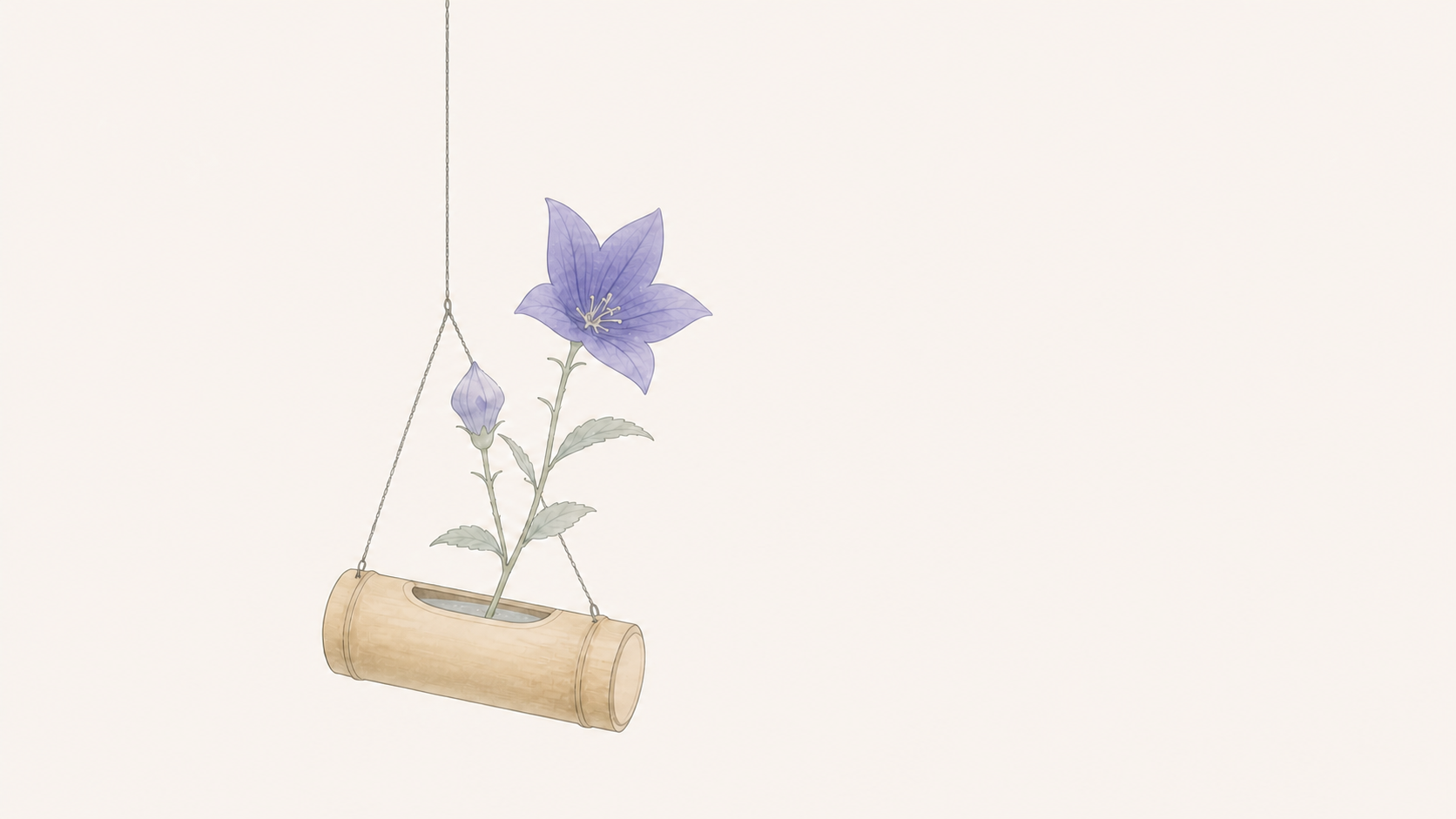
Kikyō, the balloon flower, can appear as a stem in the alcove, the shape of a sweet, a line on a vessel, or a word. Each carries something different of the passage from summer into early autumn. Begin by looking at what happens when the flower becomes a design.
The balloon flower appears as a motif as well as a living plant
Put a balloon flower in the alcove, serve a sweet in its shape, and choose a bowl bearing the pattern. The season is clear, but the whole setting may feel like an explanation. Suggesting a season takes restraint as well as addition. The bud already hints at the season before it opens. The choice is which moment in its life to show, beyond making the fully open flower a sign.
The star with five lobes is easy to recognize, and appears in patterns and sweets. A real flower, a simplified outline, and a name that calls it to mind convey the season in different degrees of detail.
The same theme changes as it moves into a different material.
Too many seasonal signs leave little to discover
Repeat the flower in the chabana arrangement, sweet, vessel, and scroll, and no one will miss the theme. Guests will have less room to discover it for themselves.
If the flower takes the main role, the sweet can echo its color alone. If the name of the sweet supplies the clue, the vessel can stay quiet. Toriawase gives the different elements different strengths.
Suggesting the passage from summer into early autumn
The seasons do not change all at once on a calendar date. Balloon flowers can suggest the approach of autumn in air that still feels like summer.
A first bloom or the last of the flowers shows a stage in the season instead of one fixed image. A tea gathering can make those thresholds easier to notice.
Carrying features of a flower into sweets and patterns
A balloon flower arranged as chabana is a living plant, down to the curve of the stem and the direction of the leaves. A wagashi maker or someone making a vessel selects features that give it away: the outline of the petals, the purple, or the shape of the bud. Another material cannot reproduce all of it.
A few cuts in nerikiri can suggest petals, and shading can suggest a flower beginning to open. A vessel’s design can set out the five lobes in fine lines alone. Words on a scroll can call up autumn without drawing the flower. Each medium makes different choices about what to keep.
This has something in common with organizing information in design. A maker picks the feature that speaks clearly in the new material. We recognize the balloon flower in a sweet or a bowl because the maker looked at it closely before carrying a feature over.
A sweet or pattern might take just one or two features, such as a corolla opening into five lobes, the contour of a bud, or a clear outline. A star-shaped cut or a spot of purple can bring the flower to mind more readily than an attempt to copy every detail.
Letting the flower resonate without repeating it
Put a balloon flower in the alcove, shape the sweet like one, and paint one on the bowl, and the season is easy to recognize. Each time the same sign appears, there is less that guests can discover.
With a balloon flower in the alcove, a sweet might suggest evening dew or the first days of autumn. If it appears on a vessel, the alcove could hold a different autumn plant. One element carries the theme, and the others can respond quietly in color, texture, or words. Toriawase makes relationships among different things.
The design question is what will be noticed first and what will only be sensed. A flower can anchor the season while a color, word, or material answers it from somewhere else in the room. The season gains depth through those connections.
When a living balloon flower is in the alcove, there is no need for the sweet, bowl, and kaishi paper to repeat its outline. The flower can offer the form, the sweet the color, and a piece of fabric the line. The season depends on where it comes through most strongly, not how many times it appears.
The living flower and its motif tell us different things
A real plant has a leaning stem, marks on the leaves, and a blossom that will only last so long. A pattern simplifies the form and can outlast the season.
A sweet translates it into shape and taste. The name translates it into words and memory. Each medium carries something and leaves something out.
The choice of medium depends on whether you want to show something living through time or let a symbolic form linger.
Coherence can come from a family of different forms
Repeating a motif can make the idea easy to recognize. In a tea gathering, repetitions can pile up until everything is explaining the same thing.
A color alone can answer the flower. A name can remain when the form is absent. Another object may leave the idea unstated. The common impression persists through these changes, giving the setting depth.
A brand faces a similar problem. The same idea can be felt differently at different points of contact, beyond showing the same logo again and again.
One flower opens several ways to see a season
When you see a balloon flower as a motif, go beyond identifying it. Which features survive: the five lobes, the star outline, the swollen bud, the bluish purple? Which ones did the maker leave out?
The living flower opens, wilts, and turns. A sweet turns a feature into something edible. The pattern on a vessel turns it into a line that can last. Moving to a new material is an occasion to choose again what makes the flower recognizable.
Tokyo Muichimotsu looks at Japanese culture through design to see choices like these. Ask what the maker kept, and a seasonal pattern begins to look like the result of observation. Moving from a flower to sweets, vessels, and words is a way to see the same season in different materials.
Conclusion
Looking at a balloon flower in a tea gathering begins with its name and goes on to ask where to show it and where to hold back. The passage from summer into early autumn can be shared among the flower, sweet, vessel, pattern, and words. Their arrangement conveys the season. The plant, calendar, pattern, and names help us ask which moment in the season each can carry.
A balloon flower can enter the gathering in more than one form.
Take the bud, the corolla, or the slender stem and let the flower, sweet, and design emphasize different things. When one takes the main role and the others only suggest the season, guests have something to discover.
Use the living flower as a point of comparison and you can see what a sweet or a pattern leaves out and what it brings forward.
 Why So Few Flowers in a Tea Room? The Shape of Wild Growth and the Space Around It
 How a Sweet’s Name Suggests a Scene Before the First Taste