
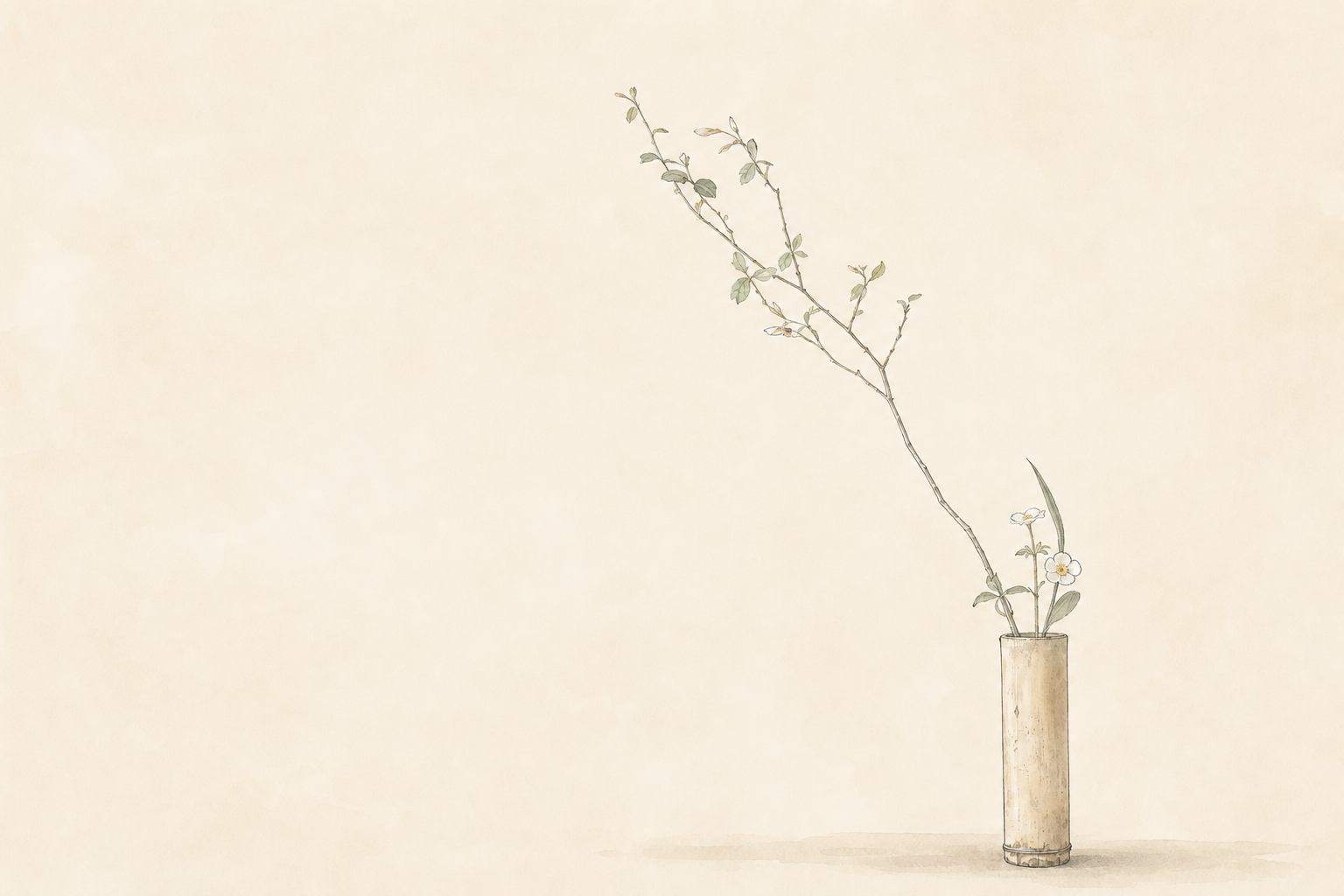
In arranging chabana, flowers for tea, you may keep just one stem. The choice is refined until the stem fits the container and the space in the alcove well enough to evoke the season for the guest. Begin with what a single stem can make easier to see.
A Few Stems Make a Stronger Impression
Flowers in a tea room seldom compete in lavishness. A small number can still direct attention to the angle of a branch, the space from bud to open bloom, and the room above the mouth of the container. Up close, the space around a flower may be larger than the flower itself. That imbalance gives the imagination time to consider where it grew and what might open next. In a single gathering, a small arrangement can hold a season we cannot see in full.
More flowers can give the room splendor. Choosing fewer can bring the line of a stem, the underside of a leaf, and the direction of a flower into view. Limiting the selection brings attention to those details.
A few flowers by themselves do not make chabana. Look at the season, the theme, the hanging scroll, and the container and decide what the arrangement needs. The care in that choice determines the quality of its quietness.
What It Means to Arrange Flowers as They Grow in the Field
In the field, light, wind, and surrounding plants are part of how a flower grows. Moving it indoors changes those relations. Chabana can convey something of what was there in the angle or line of a branch rather than trying to reproduce a whole setting.
The work is closer to translation than to a realistic depiction. The host arranges the stem with care without letting the work draw attention to itself. A natural appearance can come from making the marks of that work less conspicuous.
The container and the empty part of the alcove belong to the same view.
Isolate the flower and you see only half the arrangement. Bamboo, basketry, or fired ware in the container, the color of the alcove wall, and the distance from the scroll all change how the flower appears.
The open space receives the outline and gives the guest room to imagine the season. An arrangement can communicate by leaving time for an association instead of offering a full explanation.
The host can look at which way the plant was growing and where it caught the light before deciding which cut ends and leaf angles to leave. A small adjustment can fit the flower to the mouth of the container and the alcove while keeping its direction of growth legible.
How Flowers Bring the Season Without Naming It
A bud, a leaf bitten by an insect, or a slightly dry tip can tell something about the season without a label. By leaving in a stage before full bloom or the beginning of the end of flowering, the host gives guests a way to recall seasons they have seen for themselves.
Small traces of change can carry something of nature to the guest’s senses. That is one of the choices an arrangement makes.
Chabana draws on ways of looking at nature as well as conventions of practice.
There are ways of thinking about whether to use a flower ahead of its season, a flower at the end of its season, or a flower customarily avoided. The apparently free line of a branch rests on choices about what to use and what to leave out.
It is easy to produce an atmosphere by imitating the appearance of something natural. A flower for a particular day has to make sense in light of how it has grown, how formal the occasion is, the time of day, who the guests are, and what the scroll says.
Tradition gives the choice of one meaningful stem finer distinctions. Knowing a convention can give intention to a small departure from it or to a flower that appears early.
Arranging Flowers Also Sets the Pace of the Gaze
A guest may catch the color first, follow the stem, notice where it meets the container, and then look back at the space around it. The arrangement gives that short passage places to pause.
An advertisement or magazine page can work in a similar way. A larger main image is one way to make an impression. Quiet surroundings and a clear sequence of looking can let something small stay with the viewer. An arrangement for tea gives close attention room to develop.
The beauty of a single flower can be the beginning of what the guest sees. It can bring a season or a place back to mind. Part of the arrangement comes together in the person looking at it.
Fewer flowers do not automatically mean wabi.
Setting a few flowers in a weathered container can copy the appearance without retaining the sensitivity to season.
A small arrangement is a result of watching what is growing that day and understanding what the gathering is about. The number of stems comes out of those choices.
The reasons one particular branch was kept tell us how that arrangement makes sense.
Imagine the Gathering and Look at What the Flower Does
A flower can arrive differently in the morning or evening, among close friends or more formal guests. Consider the light, temperature, and level of formality in conversation and the direction or number of stems may take on another meaning.
If the scroll has forceful words, the flower may give only a hint of season. If the flower is the focus of the alcove, other things can stay quiet.
Look at the role a thing plays in the whole as well as its individual beauty. That gives each choice a reason to be there.
What might this mean for editing today?
A flower for tea offers a way of guiding someone’s attention. It can give them enough of a clue for their memory to do part of the work.
A Japanese-looking empty space is easy to imitate. The work behind it involves looking closely, finding out what lies behind the subject, and deciding what the person seeing it can be left to discover.
Small elements can carry a great deal because they have been chosen and placed in relation to one another with care.
How a Single Flower Gains Presence
Start by asking what the host kept and what they left out. In a magazine layout, there are often too many candidate photographs and lines of text. The ten things taken out might tell you more about the editor’s choices than the line that remains. A branch chosen for tea can show the same kind of decision.
After looking at a well-opened flower, look at a stem with a tight bud and an insect-bitten leaf. Such a stem may recall the damp air of the day it was gathered. A stage of change can stir a memory just as a perfect bloom can.
A single stem has to earn its place. Consider the flower container, scroll, light, and the guest’s experience to see what that stem contributes. For me, a flower for tea starts a quiet exchange about the season.
Begin with the choice of a single flower.
A photograph alone cannot show the guest’s eye level, the fragrance, or the flower opening over time. Chabana is a set of relations that goes on changing in the room.
Closing
A careful selection of flowers, the container, and the space around them can carry something of the season to the guest’s memory. The arrangement translates what the host saw outdoors while leaving the work of arranging in the background. Flower, container, alcove, scroll, and the guest’s experience come together in the conditions that let a season come to mind.
A choice to use less can bring more into view.
Look at the rise of the branch, both sides of a leaf, the proportion of buds and open flowers, and the distance between the stem and the container. When you can follow the directions left in a small arrangement, the space around it can hold something of the time the plant spent in the field.
 The Camellia in Chanoyu: Bud, Leaf, and Vase from Winter to Spring
 Autumn Grasses in a Basket: The Lines and Gaps Between the Stems