
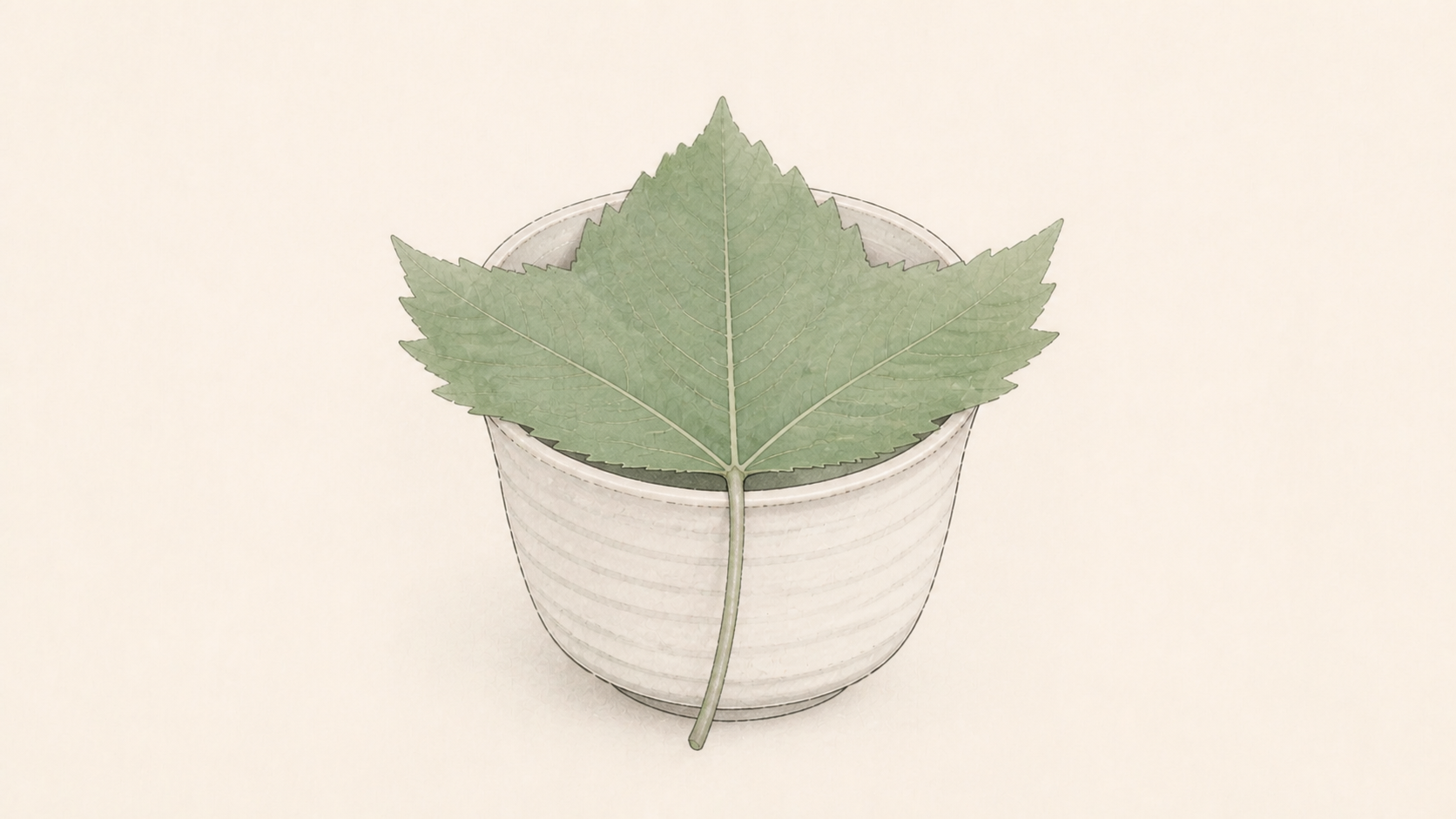
A fresh green leaf covers the mouth of the water jar, taking the place of a lid made of lacquerware or pottery. The leaf lid, or hachibuta, brings a sense of coolness to a midsummer gathering. Guests can follow the leaf from the moment it lies taut over the jar until the host folds it away. Let us follow what one leaf does from the moment it becomes a tea implement.
What is hachibuta?
Hachibuta is a hot-weather tea procedure in which a leaf covers the mouth of the fresh-water jar. An Urasenke account of a lesson describes it as an arrangement for July. At the end of its use, the host folds the leaf small and drops it into the kensui, the waste-water bowl. The kaji leaf is a familiar choice, though the point of the procedure goes beyond identifying the plant.
What catches the eye first is the contrast between the hard vessel and the soft leaf. The water jar will be used many times, while the leaf has already begun to dry that morning. Placing something so short-lived on an object that will last brings the usually unobtrusive opening of the jar into view and makes us think of the water it holds.
A tea implement can come from outside a workshop. A leaf chosen in the morning has its cut end trimmed and begins to work as a utensil as soon as it covers the jar. Once the gathering is over, a lacquer lid can go back in its box. The leaf moves between being something found in nature and a utensil, from preparation to use and then disposal, all in one day.
Why use a leaf as a lid?
A blue vessel or glass can suggest coolness in summer. The leaf brings color and more besides. Fine veins run across it and its edge has a natural wave. With droplets on the surface, light appears in points. Lift the leaf and its underside and the dark mouth of the jar come into view.
The leaf lid gives guests a sequence in which to imagine the cold. They see the leaf, then the droplets, and realize there is water underneath. They hear the host handle the leaf. The senses draw nearer to the water one at a time. The room can feel different while its temperature stays the same. In chanoyu, the season comes through as an experience.
A short life still calls for care. The host considers the direction of the veins, the size of the leaf against the jar and the way it wilts, choosing one in the best condition for the gathering. Because the leaf will only be there briefly, its condition on that particular day needs close attention.
The shape of the leaf and the sense of water
The leaf must be large enough to cover the mouth of the water jar. Its natural outline stays visible: it bulges to one side, has a slight indentation on the other and extends into a stem. The uneven line softens the regular rim of a ceramic or wooden vessel.
The leaf has work to do as a lid, so the host need not give it the prominence of an arranged flower. It serves its purpose and still shows the qualities of its material. In design terms, a part the jar requires has been replaced to suit the season, so how it works and how it looks come together in the same piece.
I think the coolness comes partly from sensing that something will only be here now. A leaf lid draws attention to the water, the leaf and its cut end, and to the way the leaf is handled at the finish. It changes what guests attend to in the heat while the heat itself remains.
A lid for a single gathering
A lacquer lid or a matching lid can be cleaned and used again. The host folds the used leaf and puts it in the kensui. The leaf that covered the jar at the start now fits into a palm. That transformation is part of the tea procedure.
Calling the leaf disposable tells only part of the story. The host picks the best leaf for the day, moistens it, gives it a job in front of the guests and handles it attentively until the end. Its brief life is a reason to give it attention. Hachibuta makes the uniqueness of a gathering visible as a change taking place in front of us.
We often prize everyday utensils for their durability and versatility. A leaf lid is used once, belongs to a particular season and never quite repeats its shape. Seeing these as the conditions that make this gathering a distinct moment helps explain why chanoyu responds so closely to the seasons.
A room small enough to hear the water
The head of the Urasenke school explains that the effect is diminished in a room too large for guests to perceive the moisture on the leaf, how it is handled, the water in the bowl and the sound of water being emptied into the kensui. The setting draws on the senses beyond sight.
In a small tea room, guests can share the soft sound of the leaf brushing against something and the faint sound of a drop falling. Hearing and proximity make coolness felt without adding more visual information. Hachibuta shows both what one implement can do and the size of room in which it can do it.
Begin by looking at the size of the leaf against the mouth of the jar and the direction the veins run. Later in the procedure, see how it has changed. Its color, curve and wetness all register the time that has passed.
Three ways to look at a leaf lid
First, look at the size of the leaf in relation to the jar. It should cover the opening, with its outline extending beyond the rim. Next, look at the moisture. A heavy coating of droplets calls attention to the effect; too little can make the leaf look dry. Finally, look at what changes after the leaf is handled.
The leaf is an implement that registers time. The taut leaf seen on entering, the leaf the host lifts during the procedure and the folded leaf at the end are all the same one. Following how its form changes in use can deepen our understanding of a tea implement.
Conclusion: Coolness goes beyond temperature
Hachibuta leads the eye from a leaf and the light on a drop of dew to the water under it. Guests hear the quiet sound of the leaf as the host handles it, then see it disappear. The sequence can make the gathering feel cooler while the room stays at the same temperature.
I think coolness has to do with how the information reaching the body is arranged. When you see a leaf lid, look at its beauty and then notice where it sends your eyes and ears.
The leaf covers the mouth of the water jar and keeps the water out of sight until it is needed. Its veins and the direction of its stem give the gathering a line to follow. Accepting a leaf that will wilt brings the water and the season of that particular day directly into the implement.
 What Is Sadō? How the Japanese Practice of Tea Designs Relationships
 The Double Ninth Festival: Chrysanthemums and a Wish for Long Life