
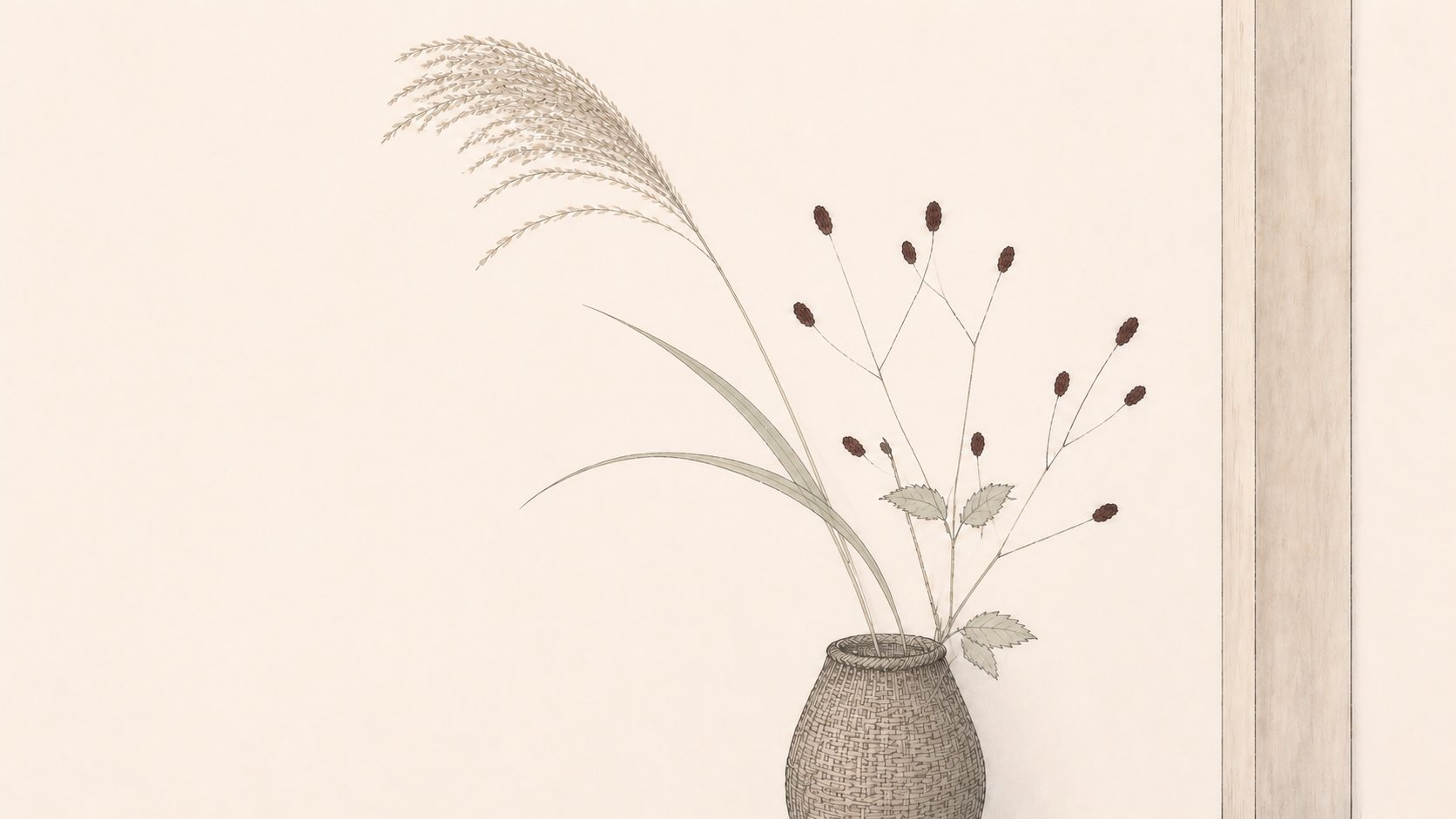
Japanese silver grass, great burnet, balloonflower, and thoroughwort are among autumn’s slender-stemmed plants. Leave room between the stems in a basket and the breadth of a field can enter the tea room. Before naming the flowers, look at the lines of the stems and what you can see through the basket.
Autumn Grasses Are Many Different Plants
Akikusa is a broad name for plants found in autumn fields. It can include Japanese silver grass, yellow patrinia, balloonflower, pinks, thoroughwort, kudzu, and bush clover. For flowers in a tea room, the choice depends on the time of year, the place, and how far nearby plants have opened that day.
Learning the names only takes you so far. Compared with many spring flowering trees, autumn grasses have slender stems that lean in the wind and flowers that are spaced well apart. The way several lines extend can say more about the season than any one petal. Start with the form.
Trying to reproduce part of a whole meadow in a basket can lead to using more flowers. What suggests the breadth of the field indoors is the direction of the stems and the air left between the blossoms. A small arrangement can leave room for a guest to imagine what continues beyond it.
Then look at the shape of the empty parts. Are the spaces between flowers narrow or broad? How much of the wall can you see through the basket? Even gaps can feel orderly, and uneven gaps can suggest moving air. Include those spaces in what you see, and a few stems can begin to suggest a field.
Why a Basket Suits Autumn Grasses
Flower baskets can be woven from bamboo and other materials. A ceramic vessel has an unbroken surface. Through a woven basket, you may glimpse the water holder inside or light from the other side. The basket looks light enough to receive fine stems without making the arrangement feel heavy below.
The vertical lines made by the stems meet the diagonals and horizontals of the weave. Where they overlap, some parts appear dense and others open. A structure becomes visible even where there are no flowers. The basket answers the flowers with lines of its own.
The basket can hold water in an insert while still letting the eye pass through parts of its weave. You can see toward the base of the stems, shadows on the other side, or the area behind the container. Those glimpses connect the flowers with the space around them.
Air and light can pass through the weave, and thin stems remain visible. The outline at the mouth looks lighter than that of a fired vessel. It takes in the sway and dry texture of the grasses without appearing too heavy.
Look at the Stems Before the Flowers
Gathering brightly colored blossoms toward the front can make an arrangement look tidy. With autumn grasses, facing all the flowers in the same direction can cost the arrangement the feeling of a field. Let one stem rise, another run sideways, and two leaves cross partway along. In different directions, the stems suggest an air current you cannot see.
Ask which line should stay visible all the way and where another leaf could cover part of it. Too many crossings can feel cramped. Lines that run in parallel can look contrived. A natural look comes from noticing the directions plants took outdoors and giving those directions room to work.
I like to keep the individuality of a stem and the sense that it grew among others. Cut them all to the same height and the result is a bouquet. Separate them too far and they become specimens. One stem can lean toward another while a flower turns slightly outward. The uneven relations suggest the time the plants spent growing.
Gaps Can Suggest the Breadth of a Field
A small tea room cannot contain a whole meadow. Open a gap between flowers, however, and the guest can imagine grasses continuing beyond what they see, with sky above. Space between the flowers can hold something of the breadth outside.
There are openings in the weave and openings around the flowers. That double openness allows a few stems to hold their own. You can see the tilt of each one. Space gives the eye more to read in a single stem.
An arrangement that looks as though it grew in a field can result from many small choices. Give the stems enough length to draw water, check the balance so they will not fall, and look from the guest’s seat. The work can stay in the background. Observation helps the arrangement look natural.
Crowd the stems and the flowers can become one mass. Change the heights and directions so that air seems to pass farther into the arrangement. A guest can imagine the distances between the places where the plants grew.
Leaving the Flowers Loose
Several species can tempt you to make a seasonal bouquet. Distributing the colors evenly and arranging the heights in steps can lend stability. In flowers for tea, the aim can be to recall one sight in the field on that particular day.
Let one stem lead and place another farther off. Give similar colors space apart and leave a line that has only leaves. When every part has a different strength, the eye can travel from one to the next. A showy autumn can be suggested by the flowers you have left room to imagine.
Think of how the stems looked outdoors and how they might look after the guests leave, as well as the moment they are put into the basket. A cut stem can take up water and gradually shift its angle during the gathering. I think the host’s responsibility is to look after a living arrangement for that period.
An Arrangement That Changes with Time
A tender autumn stem can change its angle as it takes up water, and a leaf tip can lower as time passes. If the shape is finished only at the moment of arranging, those changes will look like a collapse. Give flowers room to move a little without touching one another.
Flowers for tea are not a still picture. The shape the host sets out and the shape the plant takes afterward overlap. A guest can encounter a living plant because it has some room to change. A weak stem can give time a visible line.
You do not have to start with the names of the flowers. Follow one stem up from the mouth of the container, see where it crosses another, and look at the direction in which it leaves the group. The lines show something of the order in which the stems were placed and what supports what.
Closing | A Wide Field in a Few Stems
A small alcove can suggest the breadth of a field when the lines of the stems meet the openings in the basket and the gaps between the flowers.
The open space can hold the idea of wind and sky and of time in which a stem might lean farther. Follow a line to see where it comes from and where it leaves the arrangement.
Notice if a stem leaned or a flower opened during the gathering. That change gives a glimpse of the time the living plant spent in the room.
Look at where slender stems cross and what is visible through the weave. Keeping something of the way the air moved the stems and the distances between the plants can bring the openness of autumn indoors.
References
- Chado Research Center Galleries, Exhibitions and Catalogues
- Tankosha Editorial Department, Chabana no Irekata (How to Arrange Flowers for Tea), Tankosha
 Why So Few Flowers in a Tea Room? The Shape of Wild Growth and the Space Around It