
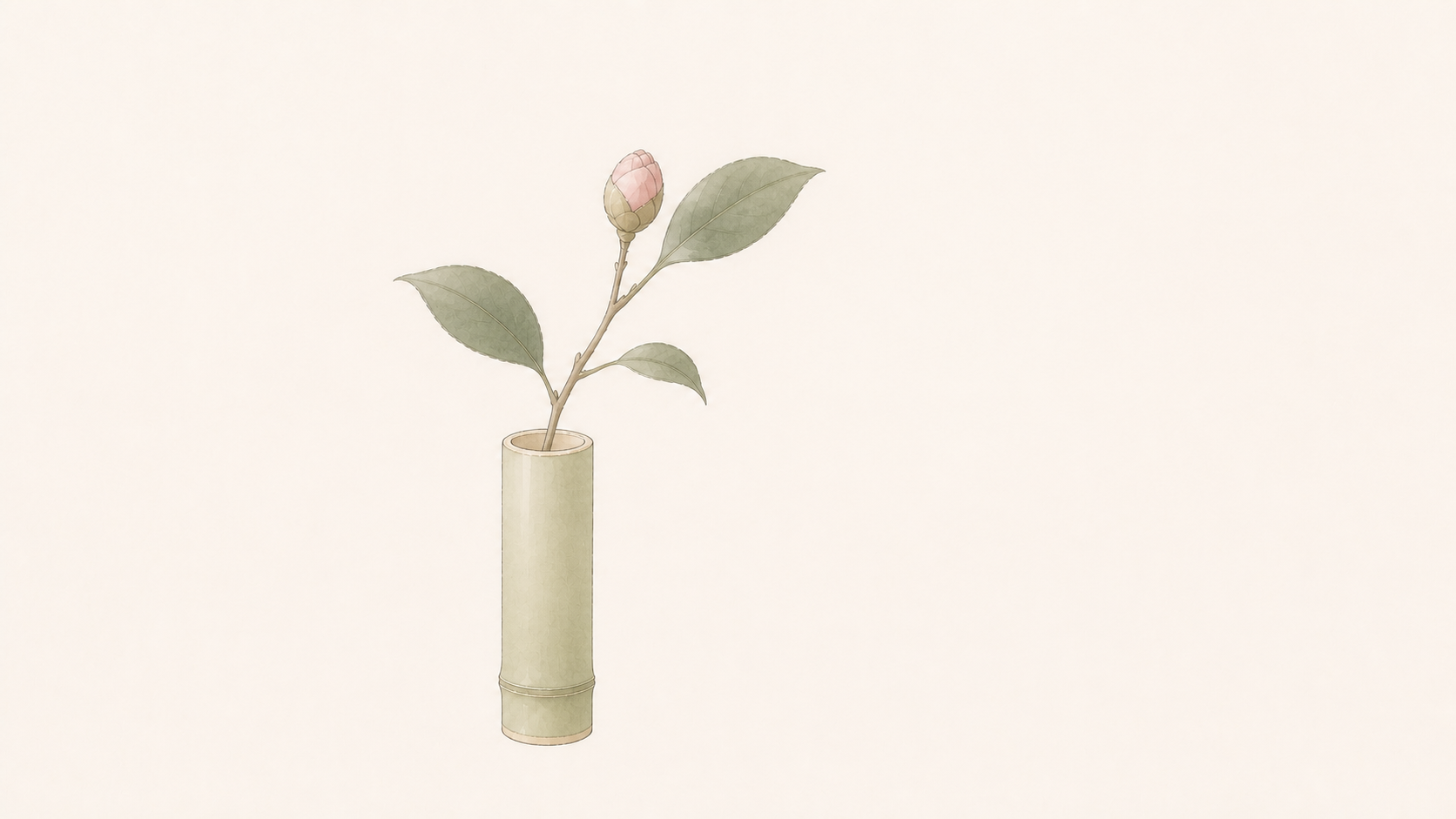
There is more to a camellia in a tea room than the beauty of a red flower. Bud, leaf, branch, time of opening, vase, and hearth season all meet in the arrangement. Start with the camellia as one of the characteristic flowers of the hearth season.
The camellia is a characteristic flower of the hearth season
A bud, still partly closed, shows between thick leaves. The camellia brings the time of opening into the room, even without the display of a flower in full bloom. The gloss of the leaves, the line of the branch, and the distance between the flower and the vase all enter the picture.
Many camellia varieties flower from autumn through spring and have long been used as chabana during the hearth season. Varieties and flowering times differ enough that one image cannot stand for them all.
Alongside the name, notice how the buds, leaves, and branch look on the day.
Some varieties, such as wabisuke camellias, have a long place in the tea room. Listing names alone will not teach someone how to choose. I look at the shape of each branch, which way the flower points, and how much leaf there is, then imagine which lines will be visible in the vase. Knowledge can make observation more detailed.
I also want to remember what it means to cut a flower. Taking a branch indoors interrupts the time of the plant. Using it sparingly also bears on how much a person intervenes in nature, beyond an aesthetic of smallness. A bud has value in its own circumstances. How does the time left before it opens belong in this gathering? Asking the question of a particular branch gives substance to the space we leave around it.
A bud shows time before the flower fully opens
A camellia that looks about to open can be chosen for chabana. What enters the room is a flower in the midst of change.
The bud gives guests a chance to imagine the opening they cannot yet see and to take part in that time.
The gloss and marks of the leaves belong to the arrangement
Camellia leaves are thick and shine in the light. Their upper and lower surfaces, a hole left by an insect, and the curve of the branch all convey time as the color of a flower does.
An unmarked leaf may suit the occasion, and so may one with a blemish. Choose which details to leave in view for that particular gathering.
One camellia has a strong presence
The color and shape of a camellia are distinct. A single flower can be the focus of a room. If other flowers, the scroll, and the sweets announce the season with equal emphasis, the room can become too explicit.
If the camellia is to lead, the things around it can hold back. Toriawase adjusts how much each element announces itself.
The vase changes how the branch is seen
A bamboo, ceramic, or metal vase can change the appearance of the leaves’ gloss and the branch’s line. The width and height of the mouth affect how the branch rises from it.
The flower and the vase belong to a single composition with the space around them in the alcove.
A mood can obscure the history and standing of a variety
Camellias have many varieties and a long history. Calling every red camellia alike, or assuming any rustic-looking branch suits chabana, glosses over those differences.
Learn the variety, season, condition of the flower, and formality of the gathering before deciding why the branch belongs there.
Imagine the time when the flower falls
Camellias are also known for the way their flowers fall. A single bloom in the alcove contains the prospect of opening and of the moment when it will be gone.
A chabana arrangement accepts that short span. It brings the changing time of the plant into the room.
Varieties differ in the size of the flowers, the layering of petals, the width of the leaves, and the time of opening. They can also carry different degrees of formality as chabana. Look beyond a generalized impression of “a red camellia” to the tightness of the bud, both sides of the leaves, and the wood of the branch. Even when you cannot name the variety, you can describe what you see.
A variety name is a reason to look again at the differences in a leaf or bud.
What the camellia teaches about holding something back
It can feel helpful to show a complete answer as early as possible. A camellia bud lets someone imagine what will follow.
The useful lesson goes beyond borrowing a Japanese look. Decide how much of the change to show and how much to entrust to the person looking.
Look beyond the flower when you see a camellia
When the color catches your eye, move from it to the tightness of the bud, the two sides of the leaves, the rise of the branch, and the mouth of the vase. The parts come together in a single moment.
The variety and its flowering time are also worth looking up. Consider where this camellia came from and why it suits this day, beyond how much it looks like a tea flower.
Take in the space around it in the alcove too. The flower stands out because the scroll, wall, and light give its outline room.
A bud contains time still to come. With the leaf and branch kept restrained, the tension of that moment becomes visible. Thinking about what guests can imagine during a gathering helps choose a flower better than memorizing an old rule against full bloom.
A camellia bud conveys the turn from winter to spring
My eye goes to the bud before the flower in bloom. A fully open bloom can be avoided in chabana, but there is more to that choice than a convention of restraint. The bud still holds time in which it could open after the gathering. I think of that as a span of unfinished time a host can share with guests.
I once saw slightly marked leaves on a camellia that looked more alive than an impeccably arranged flower. In the unevenness I could see the thickness of the leaves in light and feel the time it had taken the plant to get through winter.
When choosing a camellia for a gathering, look at how open it is that day, the leaves, and its relation to the scroll and vase, as well as the variety. I see chabana as a way of reading the time of the plant and bringing it into human time with care.
Consider arranging a single camellia bud
Camellias come in many varieties, and the color and form of a flower can have a different standing in tea practice. Calling it simply “one rustic flower” misses that knowledge. Which camellia a host chooses and how it is paired with its vase depend on knowing both plants and the conventions of tea.
Any unopened flower will not necessarily do. A bud closed too tightly can look expressionless throughout the gathering. One already well open has less time ahead. The host can consider the weather and the temperature indoors when choosing a stage suited to those few hours. The design includes what could happen later. In its vase the branch can still take up water, change direction, and open a little.
Conclusion
Time left in the bud, the surfaces of leaf and branch, the variety and season, and the way the vase sits in the alcove all shape one camellia. Guests receive a flower that still has time to change. A camellia can bring the time before and after blooming into a gathering.
Knowing a camellia as chabana means getting used to noticing the plant’s time from several angles, before it opens, before it fades, and after it has been cut.
Go beyond red or white and the name of the variety. Follow the firmness of the bud, the light on the leaves, the direction of the branch, and the balance with the vase. The turn from winter to spring begins to appear in a single branch. A partly open flower has a form of its own, with change still in it.
 Why So Few Flowers in a Tea Room? The Shape of Wild Growth and the Space Around It