
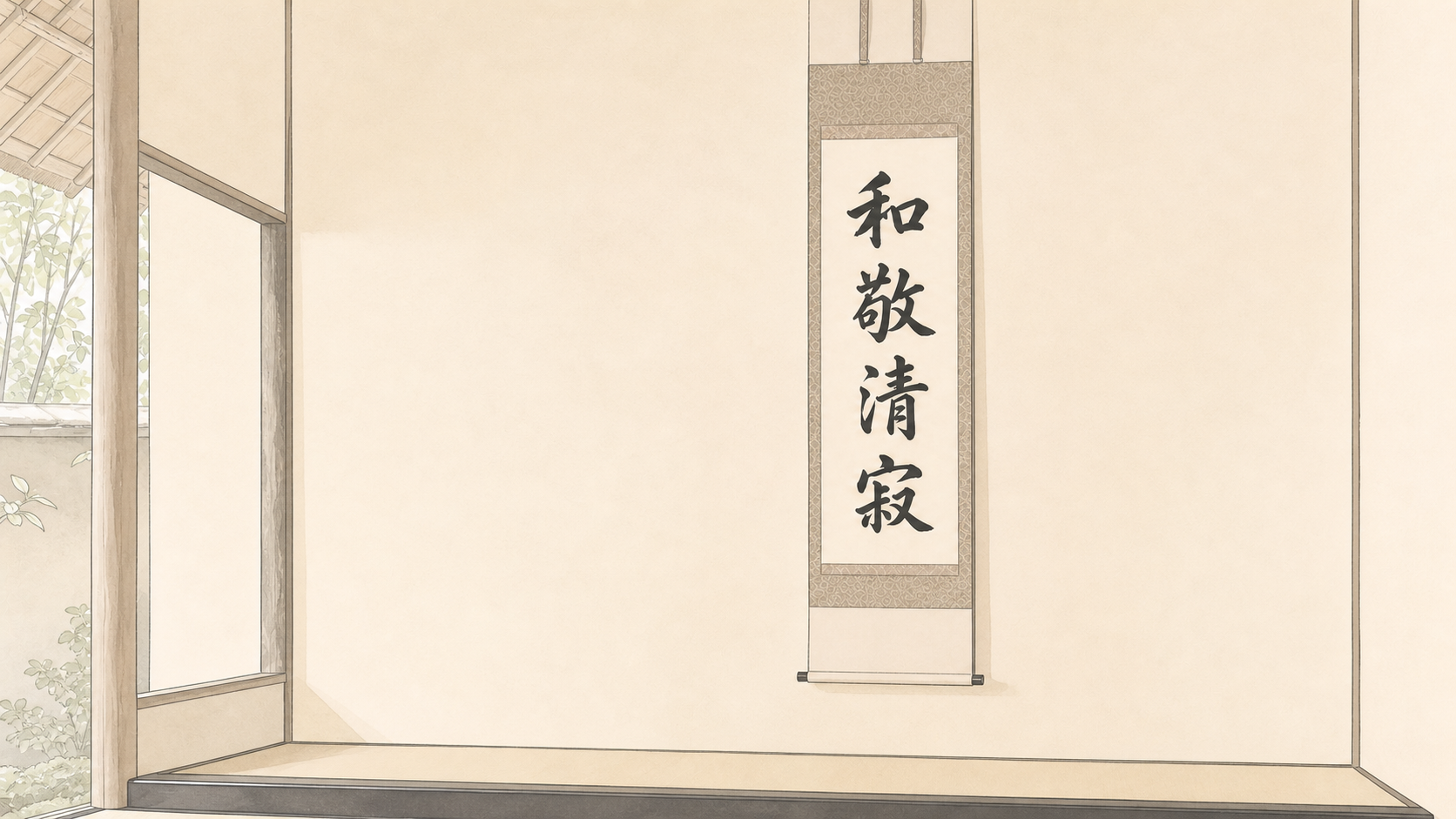
Wakei seijaku (和敬清寂) is a phrase you may see on a hanging scroll in a tea room or encounter during practice. The four principles take on a concrete meaning in the way the host and guests relate to one another and handle the utensils and space around them. What do these four characters describe in an actual gathering?
What do the four characters describe in a tea gathering?
Wakei seijaku is widely handed down as an expression of Sen no Rikyū’s ideals for tea. Wa (和) means harmony, kei (敬) respect, sei (清) purity, and jaku (寂) tranquility. Together they are known as the shiki, the four guiding principles of the Way of Tea.
The phrase is associated with Rikyū, but that does not establish that he left those four characters in writing. In the form familiar today, later generations are understood to have condensed the spirit of his tea into a brief phrase and passed it down. The way the four principles play out at a gathering brings us closer to their meaning than a search for the phrase’s origin alone.
Dictionary explanations relate harmony and respect to the conduct of host and guests, and purity and tranquility to the garden, tea room, and utensils as well. The phrase reaches beyond a person’s state of mind to the way guests greet one another, the way utensils are handled, the sweeping of the roji garden, and the quiet of the tea room.
Wa: Bringing the gathering together
Harmony can suggest a room where everyone agrees and nobody disturbs the peace. A tea gathering brings together people with different roles and levels of experience. The host welcomes the guests, the principal guest, or shōkyaku, speaks on their behalf, and the others help the gathering proceed. Each person does something different within the same shared time.
The gathering holds together because each person watches what the others are doing. While the host is making tea, the guests wait for their opportunity to examine the utensils. The principal guest chooses a question the others would also like to hear answered. Each person adjusts to the others a little.
Harmony gives different things a way to work together. A flower, a hanging scroll, and a bowl may share neither color nor shape and still belong together through the season or the theme of the gathering. That is how toriawase, the selection and arrangement of utensils, can bring a scene together. A tea gathering finds harmony in the same kind of relationship.
Kei: Respect for people and utensils
Kei extends beyond good manners toward a senior. In the tea room the host attends to the guests, and the guests in turn pay attention to what the host has prepared. Each takes the other’s time seriously.
That attention carries over to the utensils. A guest takes a bowl in both hands and sets it down between their own place and the next guest’s. When examining a tea scoop or tea container, guests avoid lifting it any higher than necessary or handling it carelessly. The price of the utensil makes little difference. Care comes naturally when the object carries the time someone spent choosing, cleansing, and presenting it.
Respect can mean giving others room and approaching them with attention to more than one’s own convenience. People and objects alike have their own histories and roles. Kei becomes a practical way of attending to what is in front of you.
Sei: Cleaning and making room for attention
Before a gathering, the host sweeps the roji, prepares the water basin, and cleans the room and utensils. During the gathering, the host also cleanses a tea container with a fukusa, a silk cloth, and wipes the bowl with a chakin, a small linen cloth. Sei begins with the practical work of cleaning.
Its reach extends further. If every last leaf is cleared from the garden, the signs of the season can disappear too. In cleansing a utensil, the host directs attention to the object about to be used and readies their own movements. The action has a purpose beyond demonstrating cleanliness to the guests.
Purity, in this sense, clears away distractions so that what deserves attention can be seen. Cleaning, cleansing, and arranging the room each help the guest’s eye find the flower, the scroll, and a bowl of tea.
Jaku: The calm that lets small sounds be heard
Jaku can bring to mind a hushed tea room. Loud voices and conspicuous noises are usually kept down, yet the water murmurs in the kettle, water falls from a ladle, and the bamboo whisk touches the bowl. People gathered together talk as well.
In tranquility, these sounds and words come through without being lost in the surrounding noise. You hear the quiet sound of the kettle because people’s attention has settled on the room they are in.
A mood of subdued solemnity alone cannot provide that calm. Harmony brings the guests together, respect guides the treatment of people and objects, and purity removes distractions. The time to attend calmly to what is happening emerges as those three principles take effect.
How the four principles work together
The four principles are at work together and support one another. Mutual respect helps the gathering find harmony. A clean room and clean utensils allow the guests to settle into the occasion. That calm in turn softens people’s words and movements.
Seen through design, wakei seijaku describes how the whole experience is arranged. The work is spread across the entrance, utensils, gestures, conversation, and cleaning, so the guests feel its effects without needing an explanation. A guest follows the roji, stoops at the low nijiriguchi, and sees the hanging scroll after entering the room. Respect and the work of preparing the space meet in that sequence. Design takes shape in a series of actions as well as in individual objects.
A well-arranged room gives little notice of the work behind it. People can find their way, give one another time, and turn their attention toward what is there to be seen. At a tea gathering, the four characters help turn an attitude into visible forms and actions.
Conclusion: Reading the four characters in the gestures of tea
Harmony, respect, purity, and tranquility are easy to memorize. In tea, their meanings appear in individual acts. A guest waits for someone else to finish moving. A utensil is set down with care. The room is cleansed so that small sounds and quiet words can be heard. The gathering takes shape as these actions come together.
The next time you see the four characters on a scroll or during practice, look for where each one appears in that day’s gathering. The words on the scroll can help you notice how people are getting on with one another and with the objects and room they share.
Harmony with other people, attention to their needs, the cleansing of utensils and space, and the quiet that follows can all be traced back to things people do during a gathering. Putting each principle in terms of a concrete action makes the Way of Tea easier to enter.
 Honrai Muichimotsu: What It Means to Be Free of Attachment
 What Is Sadō? How the Japanese Practice of Tea Designs Relationships
 What Does the First Guest Do at a Tea Gathering?