
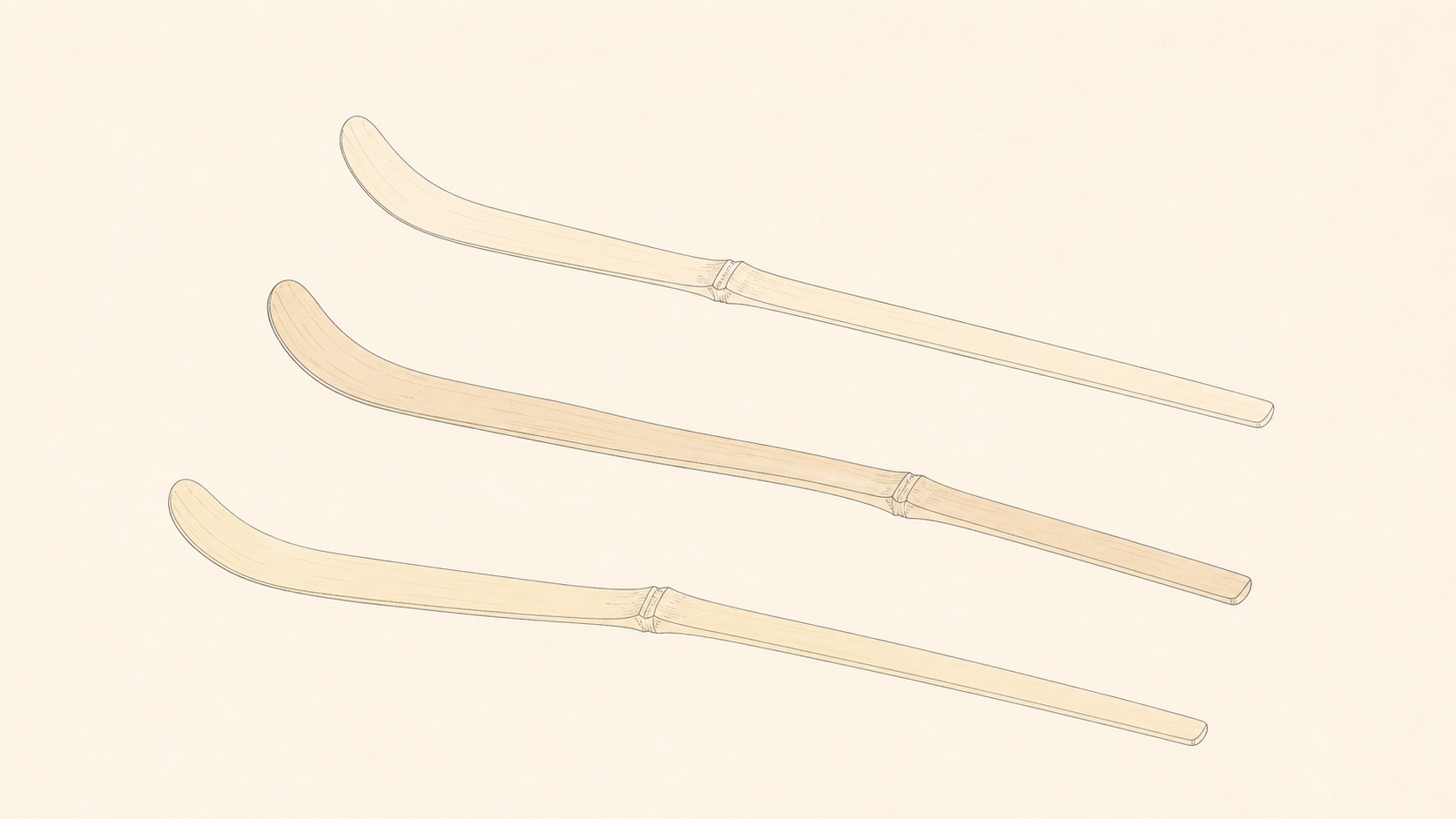
Why do these slender bamboo scoops differ when they all serve the same purpose? Look at the markings in the bamboo, the maker’s cuts, the scoop’s name and storage tube, and its relationship to the tea it lifts.
What a Chashaku Carries Besides Tea
The chashaku is the slenderest utensil in the arrangement and easy to miss from a distance. Look at the node, the width and curve of the tip, and the bamboo’s color, and you begin to see the choices that went into one scoop. Its smallness draws you close enough to notice the differences.
A mass-produced scoop could give you the same precise shape each time. A chashaku scoops tea and brings a particular material, a maker, and sometimes a name into the gathering.
What it does with tea and what it carries into the room belong to the same object.
Leaving the Node and Markings in the Bamboo
Bamboo has nodes, shifts in color, and curves. Irregularities that might be removed in factory work can give a tea scoop its expression.
The maker decides what to keep and what to cut away. The natural form of the bamboo and the shaping of the maker’s hand both contribute.
What Carving Away Leaves Behind
The maker carves a piece of bamboo to leave a thickness the hand can feel and a tip that can scoop tea. A small cut can change the strength, flexibility, and appearance.
Shaping a scoop involves finding a line already present in the material and deciding where to reveal it.
How a Name Changes What You See
A chashaku may be given a name, or mei. Once you know it, the same color or node can suggest a different scene.
A name gives the guests’ associations a direction. In a slender piece of bamboo, they may discover a season or a story.
The Tube and Inscriptions Preserve Its History
A tube, box, or inscription can protect the scoop and carry information about who made it and what it is called.
Information held outside the scoop is part of what gives this small thing its standing. The object and its record pass on together.
Before hearing the name, you see the node, the width of the tip, and the bend as physical features. After hearing it, that bend may suggest the moon, a boat, or part of a landscape. Words offer another way to look at the same shape. You can then see for yourself whether the name and scoop go together.
The Maker and the Formal Standing of a Scoop
Scoops made by well-known practitioners or makers have a history. The plainness of a form need not make one maker interchangeable with another.
There is also the work in the bamboo itself. Go back and forth between the provenance and the feeling in the hand, and the scoop’s history becomes part of a present experience.
Seeing the Scoop Beside the Caddy and Bowl
The tea caddy and bowl affect how the scoop’s color and line appear. Slender bamboo can link the objects in an arrangement, and a particularly resonant name can become the theme of a gathering.
Consider the part the scoop plays among the other utensils. That is what it means to consider its toriawase, or pairing with other objects.
One scoop comes into focus as you move between the small detail and the whole arrangement, between its name and its use.
I would hesitate to divide named scoops and those used in daily practice into objects with and without value. Formal standing and provenance matter. An ordinary scoop still shows how someone read the bamboo and made it comfortable to use. The two can carry different kinds of value.
Notice the node instead of stopping at “a slender piece of bamboo.” Ask why it was given that name. Remember where its weight sits in the hand. I think such observations are a concrete way to begin caring for an object.
A Design That Draws You Closer
The scoop does little to draw attention from across a room. Come closer and look for clues, and the node and carved surfaces become visible.
There is something to learn here for design today. A form can draw a person toward small differences and give them more to notice as they learn its background.
Looking Back and Forth Between Details and History
First look closely at the node, the curve, the tip, and the bamboo’s color. Find out about the maker, the name, and the inscription on the tube, then look at the scoop again. The same line may have a different meaning.
A simple shape can take skill to achieve. Take too much away and it loses strength. Leave too much and it feels awkward in the hand. Small differences carry the weight of those decisions.
Neither the name nor the shape tells the whole story. Looking at craft involves moving between what history tells the eye and what material tells the hand.
A scoop is too small to command attention at a distance. During haiken, the close viewing of utensils, guests can bring it near and follow the node and cuts. The way to see more is to close the distance.
How Small Differences Give Each Scoop Its Character
Several scoops side by side may look like much the same piece of bamboo. Follow the positions of the nodes, the widths of the tips, and the tool marks. Small differences suddenly seem much bigger. I like how the scoop teaches the eye to notice more.
A name can connect the bamboo to a season, person, or event. That name belongs alongside the maker, the box inscription, the provenance, the occasion, and the feeling of scooping tea with it. Both history and bodily experience are part of the appeal of a tea utensil.
A chashaku reveals its differences slowly to someone who comes close, handles it, and learns its background. I value the way attention can deepen that encounter.
To choose a scoop, consider what ceramic caddy or natsume it will sit beside, which tea it will scoop, and how its name will sound in the room. Its small size lets it convey the theme of a gathering and the host’s choices at close range.
What You Notice with the Scoop in Your Hand
The marks left by a blade show more than the appealing traces of work done by hand. What the maker cut and kept shows how they read that individual piece of bamboo. A slight unevenness is worth looking at for what it does in that scoop.
The name also places a scoop within a history and a gathering, alongside the tube, box inscription, and provenance. I pay attention to formality and provenance because of the people the object has brought into relation over time.
Take the scoop in your hand and differences that seemed slight to the eye become more distinct. The balance, the node, and the angle of the tip change the way the host scoops tea. The subtle response of objects like this accumulates with use. The bamboo’s color, node, tip, cuts, and name, and the caddy beside it, reveal just how carefully one plain scoop can be chosen.
Conclusion
Color and node, the maker’s cuts, name and inscriptions, and the distance to other utensils all give a scoop its character. Working with a natural material involves deciding what to leave. A chashaku brings those choices into the room in one small form.
The bamboo, the hand that carved it, the words that name it, and the hand that scoops the tea all come together in one slender object. Give the node and the tip time to register in the hand and see how the name fits what you feel.
A cut that looks flat in a photograph can reveal the change from one plane to the next as the light moves.
 Chabako: A Small Box Opens into a Space for Tea