
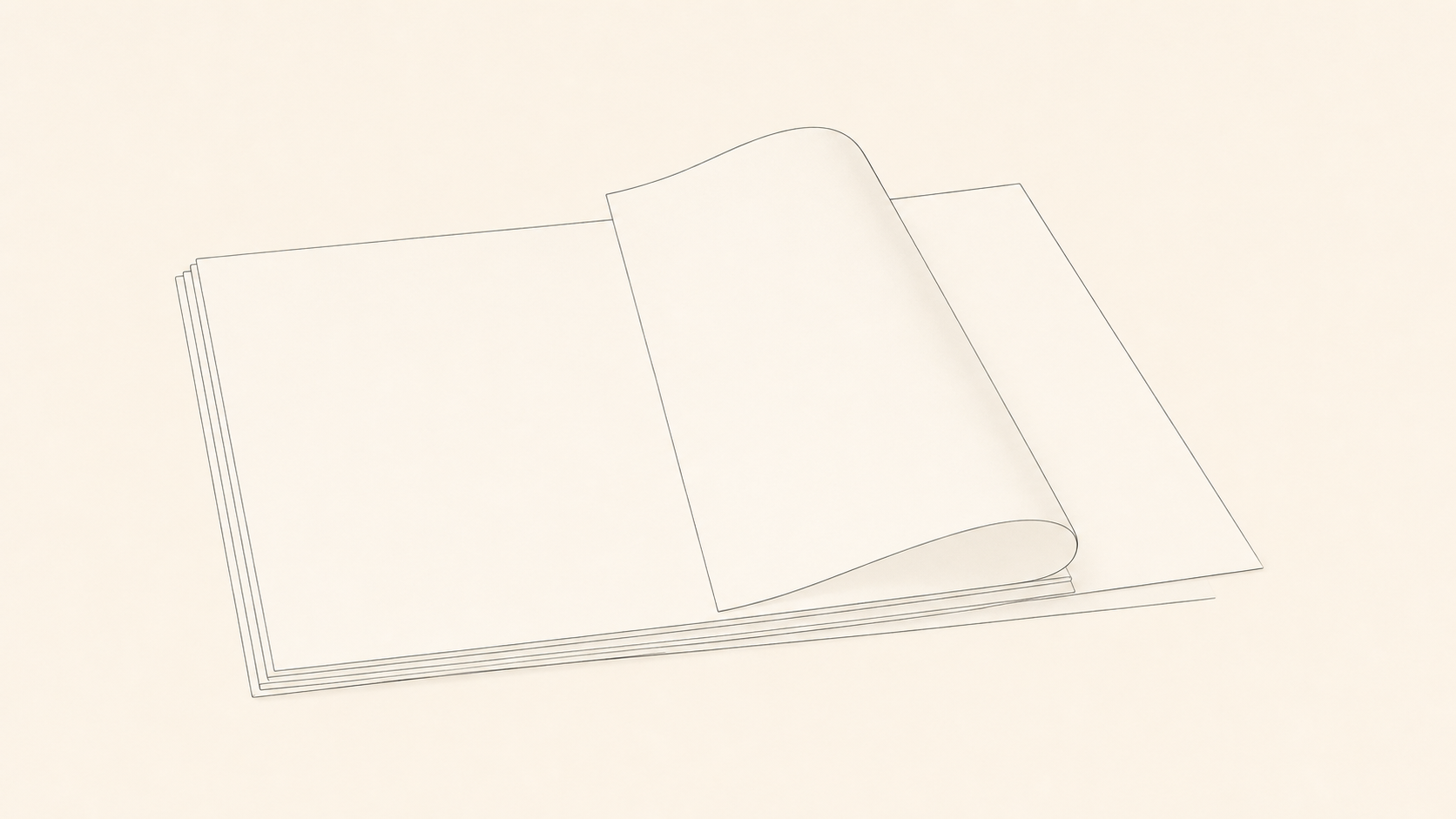
Kaishi is a small sheet of paper that a guest carries close to the body at a tea gathering. It can hold a sweet, wipe the fingertips or take on another use with a different fold. Start with the sheet as the guest carries it.
The Paper a Guest Brings to Tea
Sitting untouched, kaishi is plain white paper. Uses emerge as a guest takes a sweet on it, wipes their fingertips or folds it as needed. To me there is a richness in a tool whose functions are still open. Its shape is left for the person using it to change. A guest can carry that small freedom around in a pocket.
Along with receiving a sweet, kaishi can be used to wipe the fingertips after drinking thin tea. Precisely how it is handled depends on the school and the occasion.
The quality and dimensions of the paper, its folds and even how it is brought out all affect what the guest does with it.
A Flat Sheet Takes the Shape It Needs
A specialised container has a fixed use. With kaishi, folding, layering or turning the paper can make a surface to receive whatever needs to go on it at the time.
That flexibility is what draws me to it. A simple action by the person using the sheet brings a new function into being, in the open.
What a White Surface Shows
White paper sets off the colour of a sweet and makes it easier to see what the fingertips are doing. It also takes up stains and moisture.
As well as looking clean, the paper shows what it has received. Its white is both a backdrop and a record of use.
Between the Sweet and the Body
With kaishi in between, the sweet need not be set directly on the tatami or on the hand. The paper makes it cleaner and easier to handle and changes how it looks. It quietly regulates the distance between the object and the person.
Kaishi is unassuming, but it comes to hand as soon as it is needed. The guest can carry on without interrupting the flow of the gathering. A minimal form is enough for that work.
Disposability and Care
Kaishi may be disposed of after use. Its value lies partly in providing a clean surface for a single action.
That is no reason to idealise the consumption of paper. Use as much as the occasion calls for, and give some thought to how to take the used paper home. Care takes other forms besides keeping an object forever.
Leaving Room Around a Seasonal Motif
Kaishi can come in patterns or colours. It makes sense to choose them in relation to the sweet and the theme of the gathering. Adding more seasonal patterns does not necessarily make the setting richer.
Before dismissing blank paper as dull, I want to know what that surface is there to receive.
What the Blank Surface Makes Possible
The white sheet can hold a sweet, tidy the lips or wrap something that needs to be carried away. Until the paper is used, the surface is open to all of these actions. This is blank space in a practical sense: room for something that is about to happen.
Using a specialised tool for each task would make each function clear. Kaishi takes a different approach. Fold, layer or turn the same flat sheet and it can do what is needed there and then. Keeping the form open lets the guest respond to small changes during the gathering.
In design, blank space is often discussed as a matter of visual refinement. This blank space holds a sweet, takes a fold and absorbs a stain. It makes room for an action whose form has yet to be decided. The user makes the shape each situation calls for. The guest brings out the paper, works out which way to hold it, folds it, takes something on it and puts it away. In that brief sequence, the action is accommodated without adding another object. I see the crease as a line the guest draws into the design on the spot.
Following the Paper in Use
I like to follow a single sheet from the moment it comes out of the stack to the moment its work is done. Where is it held? Which way does it face? How far is it folded? The size and stiffness of the paper and the feel of each side become differences you can recognise once the sheet is in your hands.
A stain or crease left by a sweet shows what the paper took on. The blank space before use has become a record of an action. The care in using kaishi lies in bringing it out readily when it is needed, even when doing so leaves a mark on the white paper.
Reading about kaishi turns up names, dimensions, origins and rules. A list of these facts leaves the object in front of the reader looking much the same. Once I have checked the facts against sources, I ask how a rule changes the speed of the hand or the distance between people. Knowledge can help us look more closely. Keeping documented fact distinct from an editorial reading, I want to show the relationships visible in the object: how a form or procedure has come to work with surrounding objects, people, seasons and time, and what that can help us notice in daily life.
The Care One Sheet Can Offer
Kaishi is small and seldom the focus of a tea gathering. By carrying it, the guest can promptly make room between their body and a sweet or utensil. Part of being prepared as a guest is being able to manage that action without asking someone else to provide a new object.
Leaving room takes preparation. The guest chooses the paper, folds it to carry and keeps it ready for whatever use arises. The sheets stack thinly and fit inside the front of a garment. A guest can carry several possibilities without getting in the way of their own movements. The white surface is reserved for an action they have yet to choose.
The next time you use kaishi, look at it before you fold it. Notice which surface you use, what goes onto it and when its work is done. You can see a sheet of paper take on the role of a utensil as the occasion calls for it.
Design shows up in more than expensive objects. Even a short-lived object can embody ways of relating to things and to other people that a culture has refined over time.
Calling kaishi “Japanese” or “minimal” too quickly can obscure what is there to see. Look closely at the marks on the material, where the hand touches it, the space around it and the sequence of movement.
Closing
In a tea gathering, kaishi carries the sweet, keeps a little space between it and the body, wipes the fingertips and takes on different uses as the guest folds it. As it passes unobtrusively from one task to another, it retains the traces of each. What I see here is a design that leaves the shape open for the person who will use it.
Much of its versatility comes from the simple things guests can choose to do with it then and there: fold, layer, receive or wrap. One sheet leaves room for those choices in place of several different tools. The design supports the gestures right through to the creases and the used paper.
Deciding how many sheets to carry and how to fold them is also a small way of preparing for the length and demands of a gathering.