
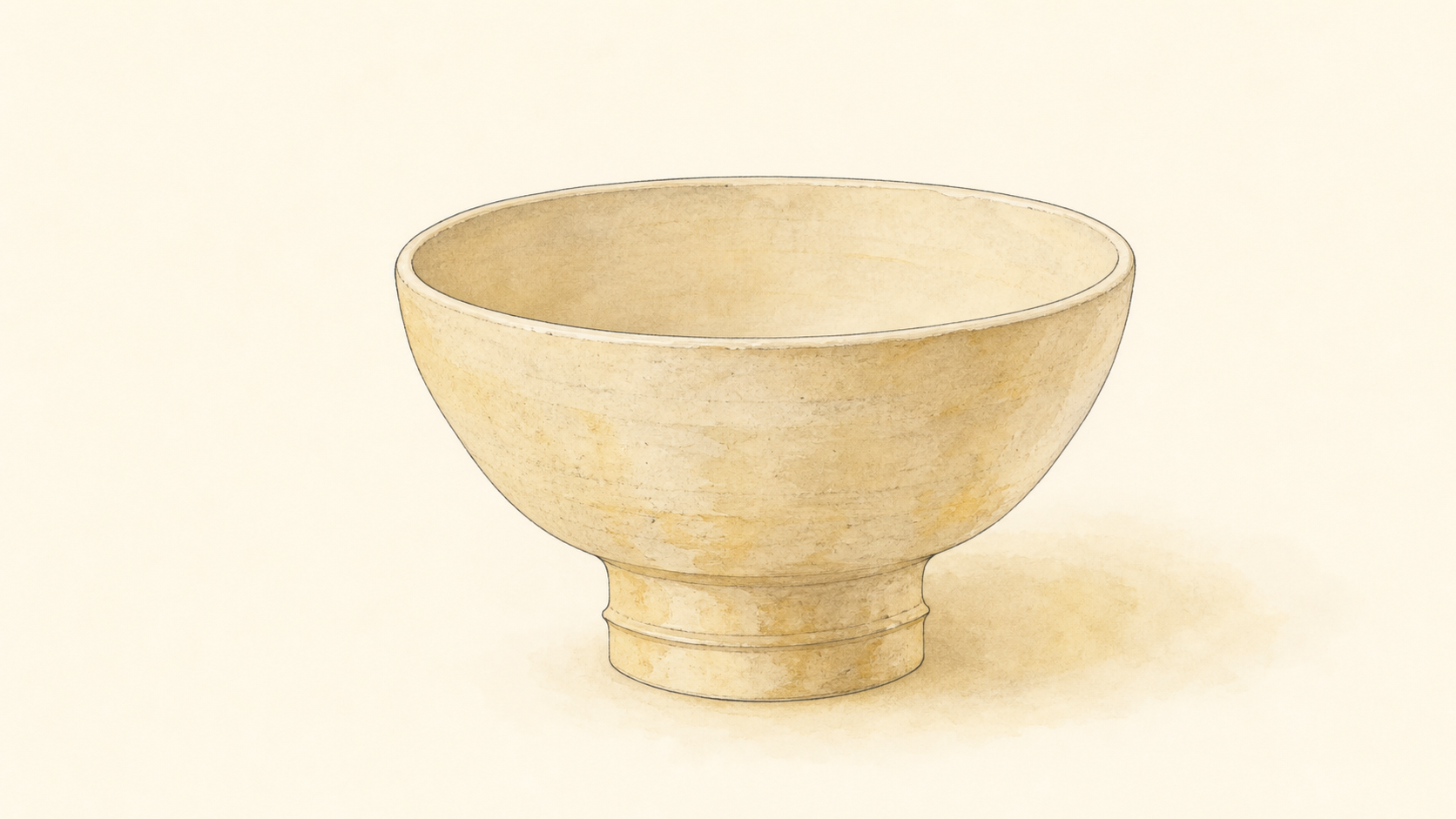
Many Ido tea bowls began as everyday vessels on the Korean peninsula. After they reached Japan, tea practitioners came to prize them. These bowls show how the people who use an object can discover qualities beyond what its maker may have intended.
Ido within the family of Korean tea bowls
Ido is one kind of Kōrai chawan, an umbrella term for bowls made on the Korean peninsula and used in Japanese tea. It includes Mishima, kohiki, and hakeme as well as Ido. Kyoto National Museum notes that tea practitioners particularly esteemed Ido bowls and that they had already reached Japan by the sixteenth century. Distinctions such as large Ido, small Ido, and blue Ido show how closely they looked at the differences among bowls.
These categories give people ways to describe color, size, glaze, and overall appearance. Several explanations have been proposed for the name Ido. The name alone does not determine where a bowl was made or what it was for. More revealing is how people grouped bowls by shared features and then found words for differences among them.
The categories sharpened the eye for differences. Set a large Ido beside a small one and you may notice the swell of the body and the flow of the glaze along with the difference in size.
From everyday use to the tea room
Many Korean bowls are thought to have been made for everyday use on the peninsula. Japanese tea practitioners chose bowls that could hold matcha, fit the hands, and take their place in a gathering, even when they had been made for something else. As people named the vessels, recorded who had owned them, and used them repeatedly, a bowl acquired a history.
Value accumulated through selection, use, and transmission. Later, some bowls were made specifically for Japanese orders. Among early Korean bowls, some had forms suited to another way of life that people found uses for in tea. A wide opening gave the whisk room to move, and thick walls gave the bowl a reassuring feel in the hand.
A vessel’s value can change as it finds work to do in a different setting.
An open shape that works in the hands
Some Ido bowls have a wide opening, gently rising walls, and a relatively high foot. Imagine holding one in both hands and the shape takes on another meaning. A wide mouth gives the whisk room and lets the guest see the tea. The slope of the body sits in the palms, while the foot raises the bowl a little above the tatami. Small differences in dimension and outline give the hands a different place to settle on each bowl.
When I look at an Ido bowl, I look for where the hand comes to rest. A slight swell supports the fingers, and the height of the foot draws attention to the relation between the palm and the bowl’s balance. Even a bowl that looks large in a photograph can turn out to sit within the span of two hands. The dimensions allow it to be used for whisking, receiving, drinking, and returning.
A view from the front tells only part of what a shape can do.
A loquat-colored surface and changing glaze
An Ido bowl can have the pale orange or yellow-brown color of a loquat. The clay and firing can leave gradations and small variations in the glaze. Around the foot of some bowls the glaze has drawn into a granular, wrinkled surface called kairagi. The written name evokes the bark of a plum tree. The rough surface shows where clay, glaze, and fire met.
Where the surface changes, you can see how the materials responded. Uneven glaze and kairagi need not have been added deliberately as decoration. Shrinkage, the reaction of the glaze, and the course of the firing can produce them. Tea practitioners saw resemblances to old bark or features in a landscape. Naming an incidental mark makes it possible to look for it again.
Design here can include recognizing a difference made by the materials and preserving it where others can see it.
Who saw a masterpiece in the bowl?
When the maker is known, their intention often shapes the way a work is seen. Ido bowls often have no known maker, which gives more prominence to the vessel’s use and the judgment of the people who chose it. Tea practitioners looked at its color with tea inside, its feel in the hands, and the way it sat among the other things in the room. The person who finds a new use for an object can help create its value.
An unknown maker brings the dimensions, the firing marks, the feel of the bowl, and the people who chose it into focus. On a modern product, a brand can shape expectations before we see it. With Ido bowls, people looked, used the vessel, and developed words for its value afterward.
In that sense, a name came from keeping a bowl in view over time.
Looking down to the foot in a museum
You cannot pick up an Ido bowl through a museum case. You can follow a line from the mouth to the body and down to the trimming and kairagi around the foot. Imagine the interior filled with matcha, the body in the palms, and the foot against tatami. It gives you a way to see which forms support the actions of tea and which surfaces show time passing.
If the base is hard to see, look up the dimensions or use the catalogue and display label to build on what you can see. Follow the varying rim height, look for where the glaze thins, and see how the line of the body meets the foot. Several small changes can come together into a single way the bowl would feel to hold.
Looking at the order in which a form works gives you more to notice than an immediate like or dislike.
Conclusion: A bowl that outgrew its first use
Everyday bowls from the Korean peninsula crossed the sea, were selected for tea in Japan, received names, and were handed down over a long time. Their history shows how a form that works well, changes in the material that catch the eye, and the attention of the people using it can all contribute to its beauty.
Look at the wide opening, the loquat-colored surface, and the rough area around the foot, and think about what each does in the hands. That can bring you a little closer to the attention that turned an unnamed vessel into a celebrated bowl.
Take in the wide mouth, shallow interior, foot like a bamboo joint, and loquat-colored glaze as parts of one form. Between the everyday vessel and the celebrated tea bowl lies a long period in which people looking at it differently found out what its shape could do.
 Kizaemon, Hosokawa, and Kaga: Ido Tea Bowls Through Three Celebrated Examples